
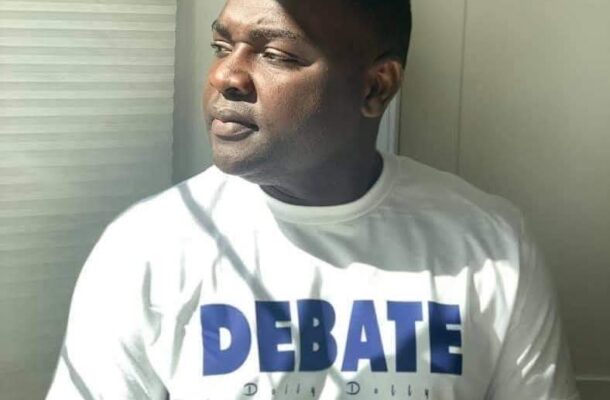
Lo and behold, Kevin is in Ghana: It was once said that if you insult a Ghanaian politician, expect a court summons. But insult a judge? Pack your bags.
You’re public enemy number one. Your photograph will be circulated on WhatsApp, National Security might sneeze your name, and the Ghana Bar Association will pretend they didn’t see anything.
This country has turned its judicial benches into political war rooms, and nowhere was that more glaring than in the attempted crucifixion of Kevin Ekow Baidoo Taylor.
In January 2020, Justice Eric Kyei Baffour issued a bench warrant for Kevin Taylor’s arrest. Not just any warrant—it dripped with condescension, bile, and an unusual craving for revenge.
The judge, whose job is to embody impartiality couldn’t help but call Kevin a “scoundrel.” That one word wasn’t just an insult.
It was a confession. A confession that the gown had been traded for boxing gloves, and the bench had turned into a stage for judicial theatre.
And yet, suddenly, the Supreme Court reminded us—perhaps begrudgingly—that Ghana is not yet a full-blown monarchy.
In a 4 to 1 ruling, Justices Omoro Issiful Tanko, Justice Simon Gbiel Suurbaareh, Senyo Dzamefe, and the ever-grounded Justice Philip Bright Mensah quashed the bench warrant.
Dissenting alone, standing like a monument to partisanship, was Justice Gaewu, whose robe many still believe came with a party card in the inside pocket.
The Court’s logic was elegant, sharp, and as old as justice itself: You can’t call someone guilty and then ask them to defend themselves in your court.
That’s not law.
In fact, the precedent had already been set in Republic v High Court (Land Division), Ex Parte Hon. Ken Agyapong, when the Supreme Court ruled that a judge had pre-judged Kennedy Agyapong and violated the sacred audi alteram partem rule.
But here’s the comedy of Ghanaian jurisprudence: Kennedy Agyapong insulted a judge on live television, in full HD. He walked free. Kevin Taylor, who did his critique with facts and fury from abroad, got a warrant.
No MP immunity. No handshake from the Council of State.
No cocktail receptions to sanitize his speech. He was expected to walk barefoot into the lion’s den, smile, and ask to be devoured respectfully.
They tried. But the Constitution tried harder.
Now here’s the juicy part.
While the Jandamists and their functionaries were busy plotting contempt charges, a rumor emerged like a whistle through a cathedral: Kevin was in Ghana. Some even claimed to have seen him at Kotoka Airport, or hiding fearfully at the residence of the VP.
Then lo and behold—he was indeed here. No police sirens. No arrest drama. Just a man walking free in the very Republic that once branded him a cyber menace.
Because let’s be honest: Kevin Taylor is not everyone’s cup of tea. In fact, he’s more like akpeteshie. He burns. He disorients.
But somehow, he clears the system.
His critiques may come like slaps, but often they land on the right cheeks.
In a country where journalists are beaten like corn dough, where media houses operate under the threat of shutdown, and where the police think being insulted is treason, Kevin became a necessary evil—or perhaps, a necessary cure.
So what does it say about us that someone like Kevin had to operate from exile, hunted through court filings like a political mosquito?
What kind of Republic turns its courts into dens of vendetta while leaving real criminals to enjoy weekend golf with their loot? The answer is bitter but true: we are still learning how to be a country of laws, not loyalties.
This ruling must not end here.
It must become a line in the sand. The State must now take a cold shower and review every politically motivated contempt charge issued in the heat of ego. Judges must remember.
They are not the law. They are its servant. The courts are not temples of pride.
They are shrines for justice.
Judges must remember: You are not the Constitution. You are just its microphone. Your job is not to punish critics for your hurt feelings.
Your job is to uphold the very rights that let them criticize you.
Because in a true democracy—even a man called a scoundrel has the right to speak. And sometimes, that scoundrel ends up being right.
P.S. I’ve received credible information that Justice Kulendi was not on the panel. I’ve made the necessary correction accordingly.
Curated from the Facebook page of Kay Codjoe
Comments