
The Northern Region’s long-standing struggle with drug trafficking, violent robberies, and entrenched criminal networks has entered a new phase following a decisive security operation led by the Inspector-General of Police (IGP)’s Special Operations Team.
For years, Tamale and its surrounding municipalities—particularly Yendi—have been plagued by rising narcotics activity and coordinated armed attacks.
Residents, traditional leaders, and institutions such as the University for Development Studies (UDS) have repeatedly raised alarms over the growing boldness of criminal gangs.
It is against this backdrop that police launched one of their most comprehensive crackdowns in the region’s recent history.
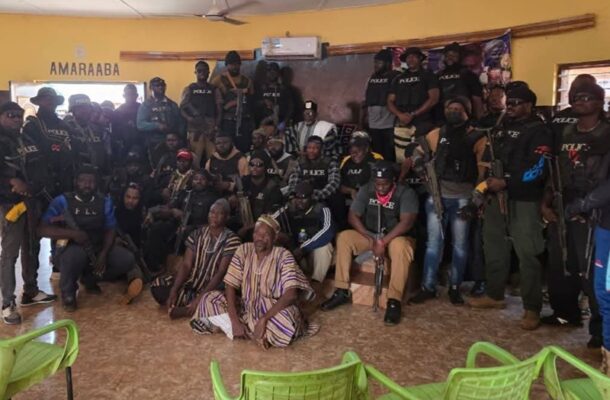
The latest offensive, executed by a 52-member elite team headed by DSP Karim Mahama and ASP Bawah Abdul Jalil, has already begun to reshape the security landscape.
Backed by eight service vehicles, including a Black Maria, the team set out to penetrate deep into suspected drug territories and robbery hotspots. Intelligence reports had earlier suggested that Tamale was evolving into a major distribution hub for narcotics, with networks linked to violent youth gangs and weapons peddlers operating freely across the metropolis.
As part of confidence-building efforts, the Special Operations Team paid a courtesy call on the leadership of UDS, Dungu Campus—an institution that had previously experienced a worrying pattern of robberies and attacks on students and staff.
The team was received by Professor Mohammed Ibrahim Gunu, Dean of the Faculty of Education, and a number of faculty members who praised the police for what they described as a “historic period of uninterrupted security.”
According to the university administration, since the Special Operations Team began operations in the area, not a single robbery incident has been recorded in the entire enclave.
The police explained their broader regional mandate: to dismantle drug networks, suppress violent crime, and restore public confidence.
Professor Gunu urged the officers to work with the Regional Security Council (REGSEC) to ensure continuity beyond the team’s eventual exit.
Police leadership assured the university that a detailed operational report would be submitted to REGSEC to help maintain the gains achieved so far.
From Tamale, the team extended its operations to Yendi—a municipality that has, in recent years, become synonymous with drug abuse, youth-related violence, highway robberies, and illegal weapon possession.
On their way, the officers paid a courtesy call on His Royal Highness Alhassan Mahama Tipariga, Overlord of the Mion Traditional Area, who expressed relief over the deployment. He noted that the Mion–Yendi corridor had increasingly become a haven for criminal activity and urged the team to take decisive steps to reclaim the area.
Upon arrival in Yendi, the team was warmly received by Kuga Naa Abdullai Adam II, the highest-ranking kingmaker in Dagbon.
He described the deployment as “an answer to long-standing prayers,” citing rising drug peddling, robberies, and assaults on travellers.
He pledged full support to the police and encouraged them to remain resolute until the drug-related gangs and robbery groups destabilising the municipality are completely weeded out.
A subsequent visit to the Gbewaa Palace further underscored traditional leaders’ support.
There, the Overlord of Dagbon, Yaa-Naa Abukari Mahama II, and his elders commended the police for responding to the security concerns of the people.
Traditional authorities across the region noted that the mere presence of the Special Operations Team had compelled several known drug hubs and criminal hideouts to shut down temporarily.
The streets, they observed, had gone unusually quiet—an early sign that criminal elements had begun fleeing.
This was confirmed during field operations. Police patrols and intelligence-led searches in known drug dens and robbery hotspots revealed that many suspected criminals had abandoned their rooms shortly after news of the deployment broke.
A targeted search of the residence of notorious suspect Iddris Abdul Wasiu, believed to be in unlawful possession of weapons, resulted in the retrieval of 38 AAA live cartridges and a Ghana Army uniform without a nametag.
Though the suspect escaped before officers arrived, the items were handed over to the Yendi District Charge Office pending further investigation.
Additional searches focused on drug peddlers yielded little, strengthening intelligence that suspects had cleared their premises in anticipation of the raid.
To curb criminal mobility, police mounted snap checks targeting unregistered motorbikes—vehicles frequently used in robberies and snatching incidents.
One rider who refused to stop when signaled was chased, arrested, and detained for further questioning.
No major incident was recorded throughout the operation. Police say the unusually calm environment in formerly notorious criminal zones shows that the offensive has significantly disrupted drug networks and displaced violent gangs.
Community members and traditional leaders have expressed renewed hope, applauding the police for restoring a sense of safety that had long been eroded.
Comments