
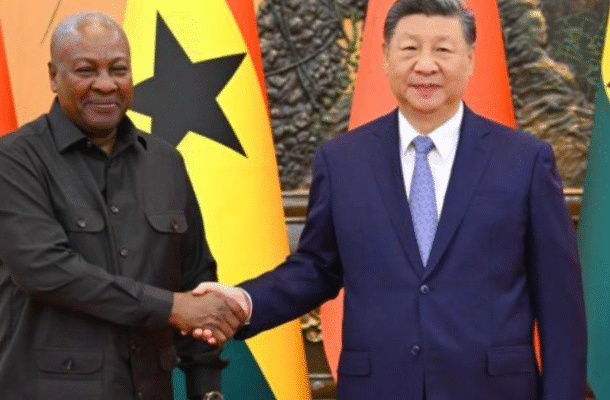
President John Dramani Mahama has called on Chinese industries to deepen their engagement with Ghana by forming strategic partnerships with local businesses to process raw materials domestically before exporting them back to China.
In an exclusive interview with China Global Television Network (CGTN), the President outlined a vision for a manufacturing-driven collaboration, moving beyond traditional resource extraction and infrastructure financing.
Ghana aims to transition from exporting raw commodities such as cocoa, timber, and mineral ores to sending higher value-added, finished, or semi-finished products to international markets. President Mahama stressed that this approach is crucial for job creation, technology transfer, and stabilising Ghana’s economy by reducing dependence on volatile global commodity prices.
“This strategy aligns with our long-term industrialisation agenda, which seeks to increase the manufacturing sector’s contribution to national GDP,” he said, emphasising the role of Chinese-Ghanaian business partnerships in achieving these goals.
The President also praised China’s pivotal role in Africa’s development, citing Beijing’s financing and execution of major infrastructure projects in Ghana, including hydroelectric dams, road networks, and port expansions. He described China as a “true friend” whose support has enabled African nations to invest in critical infrastructure and advance development objectives, offering an alternative to traditional Western development models.
Beyond economic issues, the interview touched on historical and international matters, including the enduring legacy of slavery and colonialism. President Mahama reiterated Ghana’s firm stance on recognising the transatlantic slave trade as the ultimate historical transgression and confirmed plans to champion the cause at the United Nations.
Next year, Ghana will move a motion at the United Nations General Assembly urging global recognition of the slave trade as the greatest crime against humanity. President Mahama highlighted Ghana’s historical significance as the “Gateway to Africa” and its role as a moral leader in seeking international acknowledgment and restorative justice for the atrocities of the slave trade.
Comments