
A fresh legal showdown has erupted in the legal profession following a court application seeking to suspend the activities of the newly announced Ghana Law Society (GLS) over claims that it is operating beyond the law.
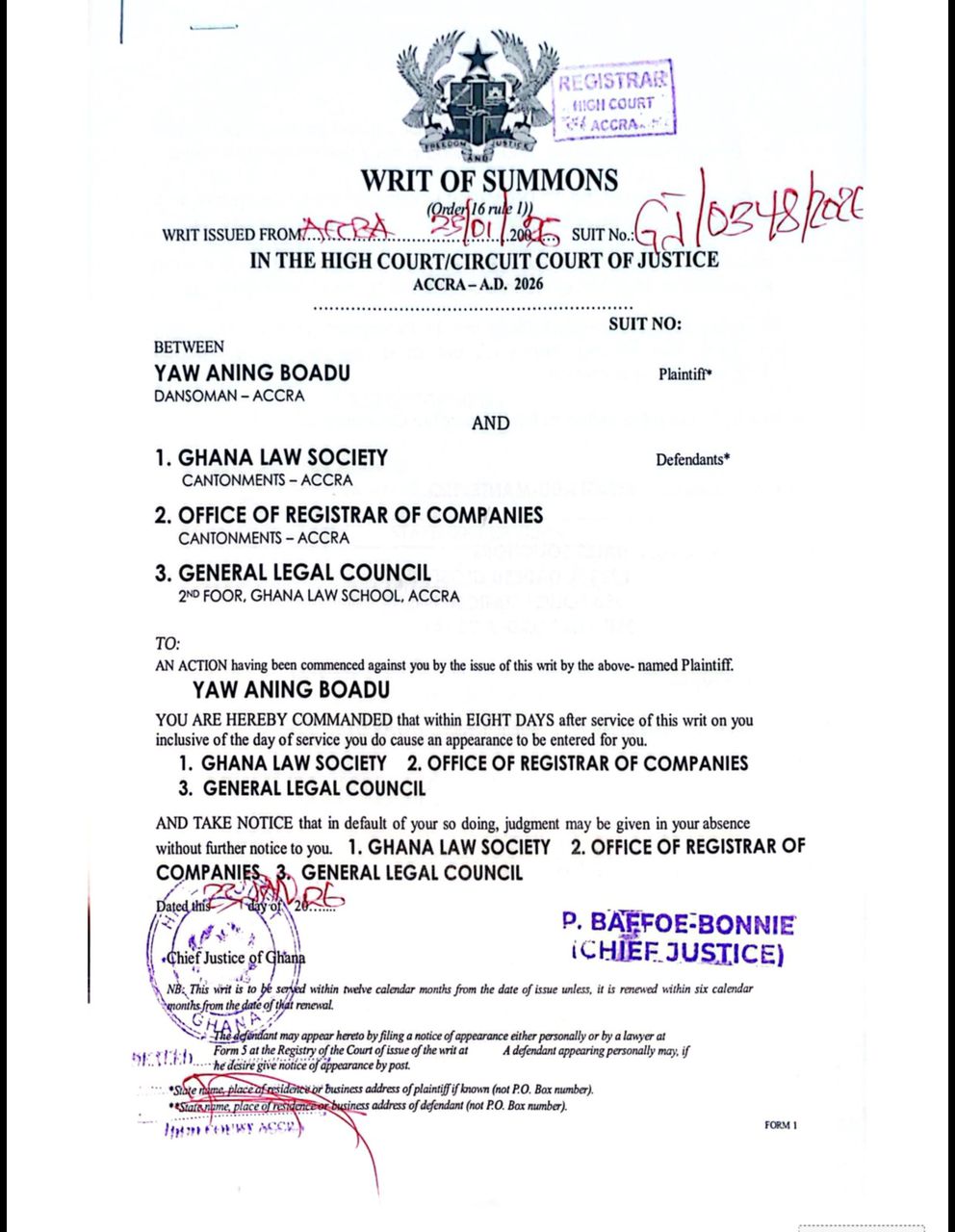
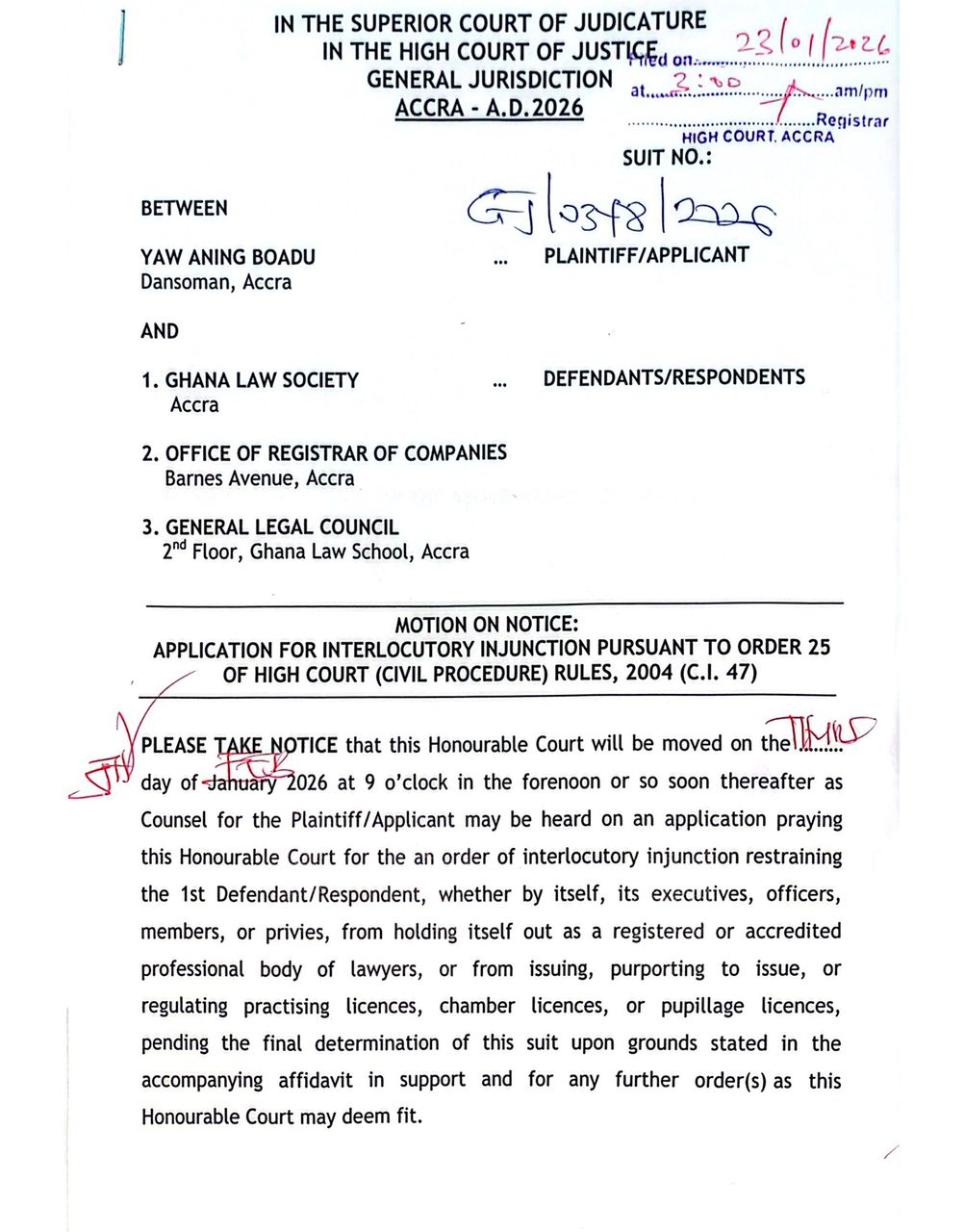
Yaw Aning Boadu, a private citizen, has filed a Motion on Notice for an Interlocutory Injunction at the High Court, asking for an immediate halt to the Society’s operations pending a full determination of its legal status.
The application, lodged on January 23, 2026, comes on the heels of a public announcement by the GLS claiming it had received official accreditation from the General Legal Council (GLC). The Society further suggested that the approval would effectively end the long-standing dominance of the Ghana Bar Association (GBA) in regulating professional legal practice.
However, Mr Boadu disputes those claims, arguing in his supporting affidavit that the GLS has no lawful authority to operate as a professional regulatory body or to issue practising, chamber or pupillage licences.
He is therefore urging the court to restrain the GLS from holding itself out as a duly recognised professional association until the matter is fully resolved.
The suit names the Ghana Law Society, the Office of the Registrar of Companies (ORC), and the General Legal Council as defendants.
At the centre of the controversy is a GLS announcement made on January 22, 2026, which indicated that the GLC—chaired by Chief Justice Paul Baffoe-Bonnie—had empowered the Society to facilitate licensing processes traditionally handled by the GBA and the GLC itself.
But according to the plaintiff, the Society’s actions are unlawful and threaten the integrity of legal regulation in Ghana.
He contends that allowing the GLS to proceed would create confusion within the profession and undermine established systems of oversight.
“Damages will not be an adequate remedy for the harm likely to be occasioned by the continued unlawful conduct, since the injury is regulatory and institutional and affects the integrity of the legal profession,” the affidavit states.
Mr Boadu’s challenge is anchored on three principal grounds. Chief among them is that the GLS has failed to meet the requirements of the Professional Bodies Registration Act, NRCD 143, which mandates that a professional body must represent at least 75 per cent of trained practitioners before it can function as a sole representative organisation.
He further argues that the Society is unlawfully assuming licensing powers that have not been granted to it by law.
The injunction, he says, is necessary to preserve the status quo and prevent what he describes as the continuation of an illegality while the court determines the legitimacy of the GLS’s registration and authority.
Comments