
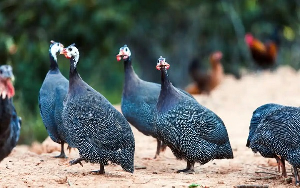
Professor Abdul-Rahman Ibn Iddriss, Dean of the School of Veterinary Sciences at the University for Development Studies (UDS), Nyankpala Campus, has called for targeted policy reforms to revitalise Ghana’s guinea fowl subsector, describing it as critical to improving food security, livelihoods and poverty reduction.
He noted that despite numerous initiatives over the years, the subsector continues to underperform due to persistent structural and technical challenges.
Prof. Ibn Iddriss made the remarks during his 23rd inaugural Professorial Lecture at UDS in Tamale, held as part of the requirements for attaining full professorial status. The lecture, themed “Nature’s Neglected Gift: Reproductive Insights into the Guinea Fowl and the Quest to Feed Africa,” drew a wide audience including traditional and religious leaders, government officials, security personnel, students and industry stakeholders.
He cited past interventions such as the Savannah Accelerated Development Authority (SADA) Guinea Fowl Initiative, the Northern Rural Growth Programme, One-District One-Factory, Planting for Food and Jobs, and the German Development Agency Guinea Fowl Initiative, noting that they failed to deliver the expected outcomes.
According to him, key challenges include high mortality rates among keets, reliance on unimproved breeds, limited access to quality feed and poor farm management practices.
Prof. Ibn Iddriss stressed that addressing these constraints through well-designed policies could unlock the subsector’s potential to reduce Protein-Energy Malnutrition, boost economic growth and improve incomes for smallholder farmers.
He called for increased government investment in research and development to enhance local guinea fowl breeds, establish proper feeding standards, develop species-specific vaccination schedules and address the issue of seasonal breeding.
He also urged the effective operationalisation of Ghana’s national research fund to support local innovation, rather than overreliance on external funding sources.
Among his recommendations was the establishment of specialised brooding centres to hatch and supply hardy grower keets to farmers, instead of vulnerable day-old keets. He added that improving farmers’ knowledge in disease prevention and management would significantly reduce mortality.
Prof. Ibn Iddriss identified limited access to veterinary services as a major constraint, particularly in rural areas, and called for the deployment of more veterinary professionals, especially in northern Ghana.
He further criticised the one-size-fits-all approach to supporting guinea fowl farmers, advocating for a differentiated policy framework that recognises the distinct needs of commercial and smallholder producers.
Additionally, he emphasised the need to strengthen veterinary extension services by equipping agricultural extension officers with the skills to provide practical training in modern husbandry and disease control.
He also recommended adopting the Triple Helix model to enhance collaboration among academia, industry, farmers and policymakers, stressing that improved technology transfer systems would ensure research innovations are effectively applied in the field.
Comments