
Royal Gold Refinery backs 24-hour economy plan to boost jobs, gold processing
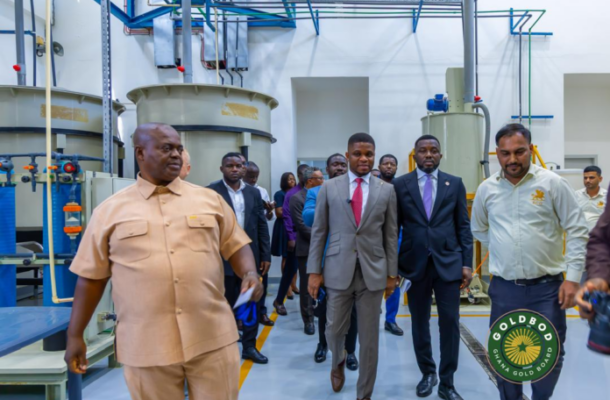
Royal Gold Refinery Limited has pledged to align its operations with the government’s 24-hour economy policy, aimed at expanding gold processing capacity and creating employment opportunities.
Chief Executive Officer Eric Frimpong Santeng said adopting a round-the-clock operational model would open up more full-time job opportunities for young Ghanaians.
His comments followed a visit by the Chief Executive Officer of the Ghana Gold Board, Sammy Gyamfi, who toured the facility to explore a potential operational partnership.
“It’s our vision to support the President’s agenda. The 24-hour economy is what we want to implement here to ensure our youth gain full-time employment. We’ve also engaged experienced technical experts to train our local workforce, who will eventually take over operations,” Mr. Santeng stated.
He disclosed that the refinery could employ about 27 workers per shift when operating at full capacity.
On his part, Mr. Gyamfi said GoldBod has engaged a technical expert to assess the refinery’s readiness and advise on the feasibility of a formal agreement.
“Our expert will work closely with them, providing continuous support and guidance. He understands the system we intend to implement,” he noted.
Mr. Gyamfi expressed optimism that both parties would soon conclude discussions and operationalise the refinery fully.
“We are confident these issues can be resolved within weeks. On my next visit, I may be accompanied by the Finance Minister, the Lands and Natural Resources Minister, and possibly the Governor, who is also a shareholder,” he added.
The Royal Ghana Gold Refinery, commissioned on August 8, 2024, has the capacity to process up to 400 kilograms of gold daily, refining it to 24 carats with a purity level of 99.99 percent. The facility represents a significant step in Ghana’s efforts to transition from raw mineral exports to value addition.
In a related development, Ghana is also strengthening its gold value chain through a collaboration between GoldBod and the Gold Coast Refinery, with technical support from Rand Refinery.
Under the arrangement, GoldBod is expected to supply at least one metric tonne of gold weekly to Gold Coast Refinery from February 1, 2026, with output projected to increase over time. The refinery has an annual processing capacity of up to 180 tonnes.
The refined gold will meet a minimum purity of 99.5 percent, with the potential to reach 99.999 percent. Exported gold bars will carry hallmarks from Gold Coast Refinery, GoldBod, the Ghana Standards Authority, and the Bank of Ghana to ensure global credibility and traceability.





Popular News
No trending posts found.