
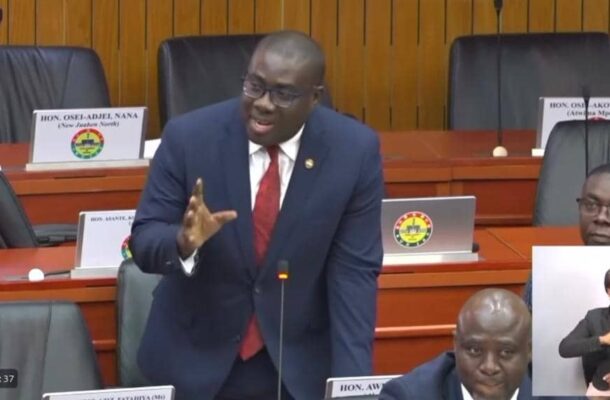
Sammi Awuku, the Member of Parliament for Akuapem North, delivered a pointed contribution on the floor of Parliament during the debate on President John Dramani Mahama’s 2026 State of the Nation Address (SONA).
Speaking with a mixture of critique and caution, Awuku used his time to scrutinize government promises, particularly on employment, utility tariffs, and the welfare of cocoa farmers.
Sammi Awuku, a former national organizer of the New Patriotic Party (NPP), began by commending the President for the confidence with which the SONA was delivered, but emphasized that confidence alone does not equate to evidence when assessing policy outcomes.
He criticized the government for what he described as a widening gap between official rhetoric and the realities on the ground. “Confidence is not evidence when it comes to measuring with the realities on the ground,” he said, underscoring the need for accountability in policy delivery.
Focusing primarily on unemployment,Sammi Awuku cited government statistics to challenge the President’s claims. According to Awuku, he tracked 112 commitments made by the government in 2025 and found that only 38 percent were delivered, leaving 62 percent “still in the pipeline.”
He singled out youth employment as a major concern, noting the discrepancy between the President’s claim of creating one million jobs in 2026 and the Ghana Statistical Service (GSS) data, which reported an increase of only 330,000 jobs in the first three quarters of 2025.
“The figures that Mr. President delivered are in complete variance with what his own government statistician told the Ghanaian people,” Sammi Awuku said.
He highlighted the situation in Greater Accra, where the GSS reports that 49.3 percent of young people remain unemployed, equating to nearly one in two youth without jobs. Nationwide, he added, approximately 1.95 million Ghanaians aged 15 to 35 remain outside formal employment.
Sammi Awuku described the administration’s employment and economic messaging as “slogans and Instagram-style governance,” arguing that policymakers must move beyond rhetoric to address real-life challenges faced by citizens.
He cited market women and local traders in Akuapem North as examples of citizens whose economic realities are not captured by macroeconomic indicators alone. “I cannot go tell them about micro and macroeconomic indicators when they are not feeling it in their pocket,” he remarked, drawing attention to the lived experiences of everyday Ghanaians.
He also criticized the slow implementation of the President’s signature “24-hour economy” initiative, describing it as “the only understatement in the President’s SONA.”
Sammi Awuku further highlighted concerns from cocoa-growing communities, recounting stories of farmers struggling with food insecurity while others pursue opportunities abroad.
He suggested that the government must prioritize the welfare of such communities to complement national development goals.
Sammi Awuku’s intervention reflects broader tensions in Parliament over the government’s ability to meet its ambitious development promises. While acknowledging some progress, he argued that systemic challenges—particularly youth unemployment and high utility tariffs—require more than political assurances to resolve.
By raising these points, Sammi Awuku positioned himself as a voice demanding tangible outcomes and accountability, urging the government to translate SONA pledges into real benefits for ordinary Ghanaians, especially the youth and rural communities who remain most vulnerable to economic hardships.
Comments