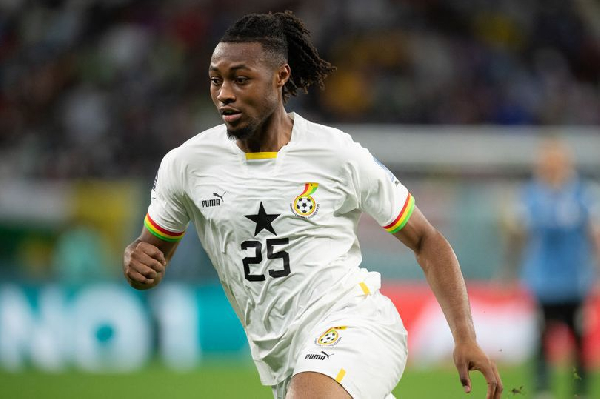
Manchester City and Ghana star Antoine Semenyo will head into the 2026 World Cup with the weight of expectation hanging heavily on his shoulders.
As evidenced by the odds on the Ghana betting sites reviewed by Bettingtop10.com/gh, the Black Stars are not fancied to go beyond the round of 32 this summer.
The lack of confidence in their chances is fuelled by the belief that Ghana lack the tactical structure to compete with the top teams at the tournament. Read on as we assess their chances.
Semenyo Needs More Support
Semenyo has made a massive impact for Manchester City since joining them from Bournemouth for £64 million during the winter transfer window.
His contribution profile shows direct running, improved decision-making and positional flexibility across the front line under elite coaching conditions.
However, while he has an environment that helps him function more effectively at City, the same cannot be said of the national team set-up.
The Black Stars have midfielders and forwards that can work efficiently with Semenyo, but the lack of a defined attacking structure is a major hindrance.
Build-up phases are inconsistent, midfield progression lacks tempo and final-third occupation fails to create scoring opportunities.
Semenyo receives the ball in isolated channels, often against compact defensive blocks with limited help between lines. The absence of Mohammed Kudus compounds the problem.
His five-month injury lay-off has left Semenyo exposed to double marking without a secondary creator to destabilise defensive shape.
Ghana’s attacking model collapses into predictability, forcing reliance on individual execution rather than structured chance creation.
Recent defeats to Austria and Germany showed the defensive disorganisation, midfield fragmentation and limited attacking cohesion.
Ghana’s Coaching Instability is a Recipe for Disaster
Otto Addo’s recent sacking took away the last layer of continuity within Ghana’s technical set-up.
The timing has interrupted tactical preparation cycles. Squad integration, role definition and game-model calibration now have no margin for error.
With the World Cup just two months away, the Ghana Football Association is under immense pressure to make an impactful decision.
Several managers have been linked to the job including Herve Renard, Walid Regragui and Kwesi Appiah.
Renard offers major tournament pedigree and tactical discipline, but his salary demands historically exceeds Ghana’s financial capabilities.
Regragui has a World Cup pedigree on his CV after leading Morocco’s historic semi-final run at Qatar 2022. He could be a shrewd appointment.
Ghana-born Kwesi Appiah has experience working with the GFA, becoming the first black African coach to lead them to a World Cup in 2014.
The 65-year-old has gone out of the country to prove himself, leading the Sudanese men's national team to the 2025 Africa Cup of Nations.
He guided them to the round of 16 as one of the best third-placed teams, including a 1-0 win over Equatorial Guinea, their first tournament win since 2012.
At this point, the Ghanaian federation must deploy a ‘plug-and-play’ solution, prioritising instant system installation over long-term development.
Managers who come in under such conditions tend to result to simplified tactics, stressing defensive stability and transitional efficiency instead of expansive attacking frameworks.
Tough Group Makes Life Difficult for Ghana
The Black Stars have been drawn in Group L alongside England, Croatia and Panama.
The two European sides are expected to dominate the group, which potentially leaves Ghana battling with Panama for third place.
Eight third-placed teams will progress to the round of 32, and Ghana will believe they can claim one of those hugely coveted places.
The composition of the fixtures could work to Ghana’s advantage. They face Panama in their first game on June 18, which gives them every chance of getting three points on the board.
Ghana will be big underdogs when they face England five days later, and will need to produce a stellar performance to take anything from the game.
Their final group stage is against Croatia on June 27. While they are formidable opponents, a point for Ghana could be enough to seal a spot in the last-32.
If Ghana can overcome their structural issues, they could enjoy a memorable summer. However, it would be a brave move to back them to get out of the group.
Comments