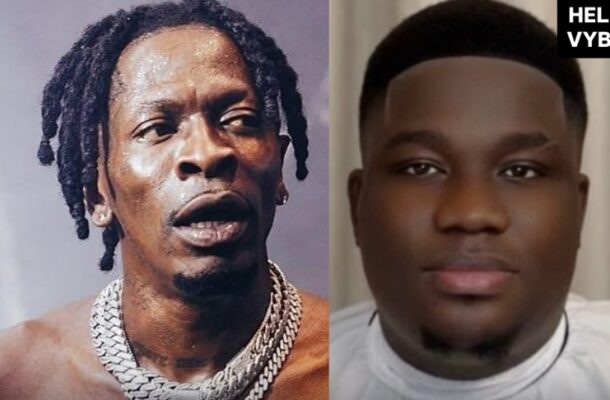
Public discourse surrounding the legal battle of Ghanaian businessman Frederick Kumi, popularly known as Abu Trica, has intensified after dancehall artist Shatta Wale openly threw his support behind the embattled socialite amid ongoing extradition proceedings to the United States.
The controversy unfolded during the Gomoa Street Carnival on April 5, 2026, where Shatta Wale used his performance platform to rally the crowd in chants of “Free Abu.”
In an emotionally charged address, the musician questioned the broader socio-economic conditions that, in his view, contribute to alleged financial crimes, suggesting that lack of employment opportunities often pushes individuals into survival-driven activities.
His remarks—“Nobody commits fraud here… We are all trying to make a living”—have since triggered widespread debate across social media and public commentary spaces.
Shatta Wale’s intervention comes at a decisive moment in Abu Trica’s legal journey.
Just days earlier, the Gbese District Court cleared the way for his extradition to the United States, where he faces charges linked to an alleged $8 million online romance fraud scheme.
The ruling followed months of legal proceedings stemming from his arrest on December 11, 2025, after a U.S. indictment accused him of participating in a transnational cybercrime network targeting elderly Americans.
Despite approving the extradition request, the court granted Abu Trica a 15-day window to challenge the decision, temporarily suspending the process to allow his legal team to file a possible habeas corpus application.
This legal avenue is expected to form the next critical phase of the case as his defence attempts to halt or overturn the extradition order.
According to members of his legal team, including Rosemary, several preliminary objections raised in court—ranging from claims of political interference to allegations of entrapment—have already been dismissed.
She acknowledged that while extradition proceedings are typically swift, the defence has managed to slow the process slightly in order to safeguard their client’s rights.
The defence has also raised concerns about the seizure of items during investigations, arguing that many of the confiscated assets do not belong to Abu Trica and are unrelated to the alleged offences.
However, their request to access these items was rejected by the court, further complicating their legal strategy.
Central to the defence’s argument is a challenge to the legal basis of the extradition itself.
Lawyers led by Oliver Barker-Vormawor contend that the charges—particularly wire fraud and money laundering—do not fall within the scope of the 1931 extradition treaty between Ghana and the United States.
They argue that these offences are not explicitly listed in the treaty and therefore cannot be applied retroactively through modern legal interpretations.
Abu Trica’s legal troubles have been marked by a series of dramatic developments. After his initial arrest, he was temporarily discharged by the Gbese District Court on January 26, 2026, following the withdrawal of earlier charges by the state.
However, he was immediately re-arrested by the Narcotics Control Commission (NACOC), with prosecutors subsequently filing fresh charges, including conspiracy to defraud by false pretence and money laundering.
Meanwhile, U.S. prosecutors maintain that Abu Trica was part of a criminal syndicate that, since 2023, used artificial intelligence and fabricated identities to deceive victims into sending money under false pretences such as medical emergencies, travel expenses and investment opportunities.
Comments