
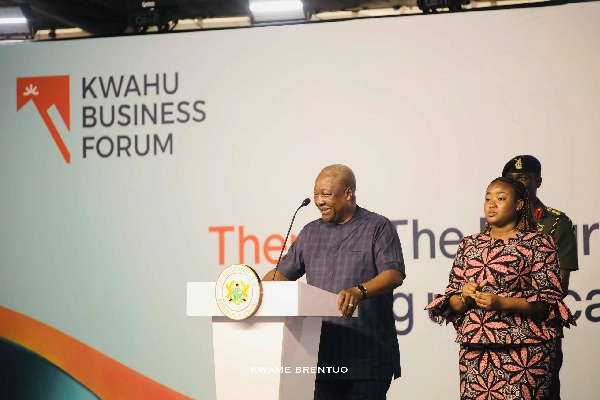
President John Dramani Mahama has stirred public conversation after offering an unconventional illustration of how his flagship “Big Push” infrastructure programme circulates money through the economy—extending, as he put it, even to “side chicks.”
Speaking on the broader economic effects of the initiative, Mahama explained that the benefits of large-scale infrastructure investments do not end with contractors, engineers, and artisans directly involved in construction.
Instead, he argued, the financial gains ripple outward into households and informal sectors, creating a chain of economic activity that supports various small businesses.
According to the President, once contractors receive payment for projects, the money spreads beyond the worksite.
He noted that these contractors often spend on personal assets such as vehicles—benefiting car dealers—and also share income with their spouses and partners. It was in this context that Mahama made the now widely discussed remark that “the wives and the side chicks also benefit,” a statement that has since dominated public discourse.
John Mahama elaborated that when money reaches these recipients, it is further injected into the economy through everyday spending.
He cited examples including expenditures on hairdressing, clothing, jewellery, and handbags—activities that directly sustain local entrepreneurs such as dressmakers, beauticians, and retail traders.
In his view, this informal redistribution of income is a vital but often overlooked component of economic stimulation.
The “Big Push” programme, a major policy proposal associated with Mahama and the National Democratic Congress (NDC), is designed to accelerate infrastructure development across Ghana, with the aim of boosting job creation and economic growth.
Historically, Mahama has positioned the policy as a continuation of his administration’s emphasis on roads, schools, and public works during his previous tenure as president from 2012 to 2017.
In his recent remarks, Mahama also highlighted what he described as a positive shift within the construction sector, expressing pride in the increasing number of young professionals—particularly women—taking up leadership roles on project sites.
He noted that the presence of young female engineers in hard hats overseeing major works reflects both progress in gender inclusion and the broader opportunities created by infrastructure investment.
Despite these broader economic points, it is the “side chicks” comment that has captured public attention, generating mixed reactions across social and traditional media. While some critics argue the phrasing was inappropriate for a leader discussing national policy, others interpret it as a candid—if controversial—acknowledgment of how money circulates within Ghanaian society beyond formal structures.
Comments