
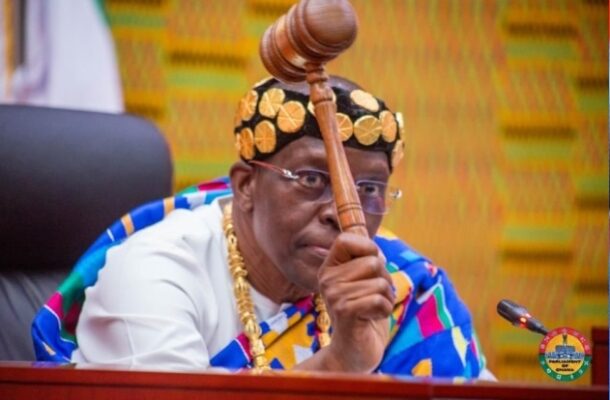
The Fourth Republic has witnessed a dynamic and sometimes dramatic evolution in the office of the Speaker of Parliament.
From politically neutral arbiters to seasoned legislators rising through the ranks, each Speaker has left a distinct mark on the nation’s democratic journey.
But the current Speaker, Rt. Hon. Alban Bagbin, is now at the centre of one of the most contentious moments in parliamentary history — raising questions about the future of parliamentary neutrality.
Ala Adjetey: The Chairman Who Delivered Fairness
The story begins in 2000 when the New Patriotic Party (NPP) secured its first electoral victory under President John Agyekum Kufuor. Behind that victory stood the party’s former National Chairman, Peter Ala Adjetey, a strategic and widely respected figure.
After the historic win, President Kufuor appointed him Speaker of Parliament — a move sharply criticised at the time.
Detractors argued that appointing a partisan party chairman risked turning Parliament into an extension of the Executive. But the opposite unfolded. Ala Adjetey earned admiration across the political divide for his neutrality and firm commitment to parliamentary independence.
His stewardship was so well-regarded that in 2004, when President Kufuor replaced him with Ebenezer Begyina Sekyi-Hughes, even the opposition voiced its disappointment. They preferred the stability and fairness Ala Adjetey had come to embody.
A Tradition of Non-MPs As Speakers
Until 2013, the Speakers were historically appointed from outside Parliament. They were individuals who had never served as MPs — a deliberate design to insulate the office from raw partisan muscle.
That tradition held until the Mahama era.
Doe Adjaho Breaks Tradition
In 2013, the then President John Dramani Mahama appointed Edward Doe Adjaho as Speaker after he had been elected MP for Akatsi South.
He became the first Speaker selected from the sitting Parliament. Though many feared this would erode neutrality, Adjaho won respect from both the Majority and Minority benches.
He presided with calm professionalism, rarely dipping into partisan trenches. For the first time, a former MP proved that internal experience did not have to produce political bias.
Prof. Mike Oquaye: Firm, Experienced, and Sometimes Contested
Following the NPP’s return to power in 2016, President Akufo-Addo appointed Prof. Aaron Mike Oquaye, a respected academic and former MP. Oquaye’s tenure was largely seen as structured and efficient.
He navigated a turbulent period marked by heated legislative battles, though some among the opposition complained about certain rulings they believed tilted in favour of the government.
Still, he maintained a reputation for discipline and adherence to constitutional procedure.
The 2020 Parliamentary Earthquake: Alban Bagbin Emerges from the Opposition
Then came 2020 — a watershed moment. For the first time in the history, a Speaker of Parliament was elected from the opposition party while the ruling government lacked a clear majority.
Alban Sumana Kingsford Bagbin, one of the most experienced legislators since 1992, became Speaker at the most fragile moment of the parliamentary democracy.
Many, even within the NPP, were uneasy. A hung Parliament and an opposition Speaker created a power imbalance unseen in previous administrations.
Still, Bagbin’s decades-long service — Minority Leader, Majority Leader, and respected parliamentary strategist — raised hopes that he would prioritise stability over partisanship.
A Controversial Tenure And Rising Accusations of Partisanship
Those hopes have since dimmed for many observers. Alban Bagbin’s era has been marked by frequent parliamentary chaos, walkouts, physical confrontations on the floor, and procedural disputes. Critics argue that his rulings and administrative decisions often deepen partisan tensions rather than soothe them.
Some MPs recall the tenures of Ala Adjetey, Doe Adjaho, and Mike Oquaye as comparatively calmer periods where controversial matters were handled with balance, even under intense political pressure. In contrast, Bagbin is now facing accusations of being the “most partisan Speaker” since the Fourth Republic began.
The Kpandai Decision: A Constitutional Low Point?
The latest controversy concerns the declaration of the Kpandai parliamentary seat vacant despite ongoing court processes.
Many political watchers insist that until all judicial avenues are exhausted, such a declaration is premature and potentially unconstitutional.
To critics, it marks the lowest moment for the current Speaker — a decision they believe undermines parliamentary stability and dents Ghana’s democratic integrity.
Comments