
“They don’t work on weekends” — Former AG blasts arrest of Abdul Hanan
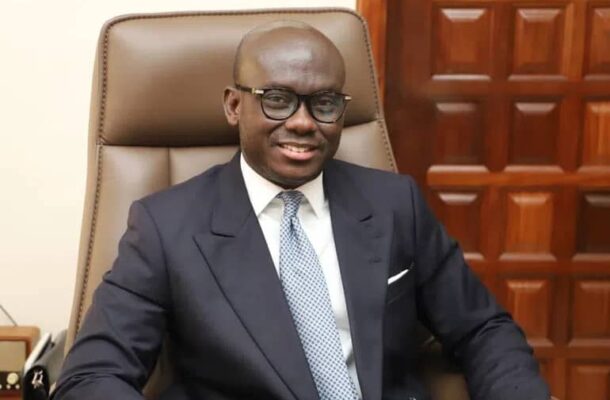
The legal establishment has descended into bitter recrimination as a former chief prosecutor lashed out at his successor’s handling of a businessman arrested mid-escape attempt, characterising the detention as a rights violation executed through procedural sleights of hand rather than legitimate law enforcement authority.
Godfred Yeboah Dame, speaking on Channel One Newsroom on Sunday, July 5, articulated grievances regarding the weekend apprehension of his client Hanan Abdul-Wahab at Kotoka International Airport.
The former Attorney-General described a scenario in which law enforcement denied him and his client’s wife access to the detained businessman, citing a institutional protocol claiming that investigative agencies cease operations during weekends.
Dame’s incredulity at the explanation was barely contained. If weekend operations cease, he wondered aloud, how could officers justify apprehending individuals during those same weekend hours?
The logical inconsistency suggested, in his view, that institutional procedures were being selectively invoked to prevent legal representation and obstruct judicial protection of the accused.
“I was not granted access to my client. They said they do not work on weekends. So I asked how they picked a person on a weekend, and yet they do not work on weekends. I was there with Hanan’s wife, and we were denied access. I do not know what they are doing to him,” Dame stated.
The legal dispute extends to substantive questions regarding the justification for Abdul-Wahab’s detention. Deputy Attorney-General Dr. Justice Srem-Sai had attributed the arrest to an alleged attempt to access funds held within a frozen bank account — a characterisation Dame rejected as legally baseless.
The crux of Dame’s argument: the freezing order invoked by prosecutors expired when the Attorney-General’s office withdrew charges against Abdul-Wahab and subsequently rearrested him.
That withdrawal triggered the termination of all prior court orders, including asset preservation directives. For a freezing order to remain operative against the newly charged defendant, prosecutors must apply to the court for renewal of the freeze — a procedural requirement they apparently chose to circumvent.
“How can one attempt to withdraw money from a frozen account? It is even incorrect to say there is an order freezing the account because that order was granted about a year ago under the earlier arraignment of Hanan before court, and it lapsed when the Attorney-General withdrew all the charges and he was rearrested,” Dame explained.
He pressed the logical inconsistency further. If prosecutors believed Abdul-Wahab’s assets required sequestration, they possessed a straightforward remedy: petition the court for a fresh freezing order tailored to the new charges.
Their failure to pursue that transparent legal pathway suggested, in Dame’s assessment, that institutional preference for summary action trumped adherence to due process.
“If the Attorney-General desires a fresh freezing order, all they need to do is apply for one. Why doesn’t he want to apply for a fresh freezing order? Why is he resorting to this means of violating the rights of an accused person?” he questioned.
Dame extended his critique to encompass broader institutional practice, contrasting his tenure as Attorney-General with what he characterised as the current regime’s casual disregard for procedural constraints on state power.
During his stewardship of the office, he asserted, high-profile accused individuals — including Dr. Stephen Opuni, Seidu Agongo, Dr. Kwabena Duffuor, Ato Forson and Collins Dauda — maintained the capacity to travel in and out of Ghana pursuant to court-approved arrangements. None were arrested at airports. None had their movement curtailed absent specific judicial determination.
“I served in that office. Never once did I authorise the arrest of any person. Never once did I authorise the curtailment of a person’s right to movement. Dr. Stephen Opuni, Seidu Agongo, Dr. Kwabena Duffuor, Ato Forson, Collins Dauda and many others were travelling in and out of the country pursuant to court orders.
There was never an occasion I authorised an arrest at the airport,” he stated.
The arrest itself unfolded during what was intended as Abdul-Wahab’s legitimate departure for the United Kingdom to attend to medical requirements — a journey undertaken with court authorisation.
Officers believed to be from the Bureau of National Investigations intercepted him as he approached departure, triggering a confrontation between law enforcement and the accused’s legal team that has now escalated into public institutional conflict.
While Deputy Attorney-General Srem-Sai maintains the action was fully justified, Dame insists that no valid legal foundation existed for the detention and that systematic denial of access to counsel constitutes a fundamental violation of the accused’s constitutional protections.






Popular News
No trending posts found.