
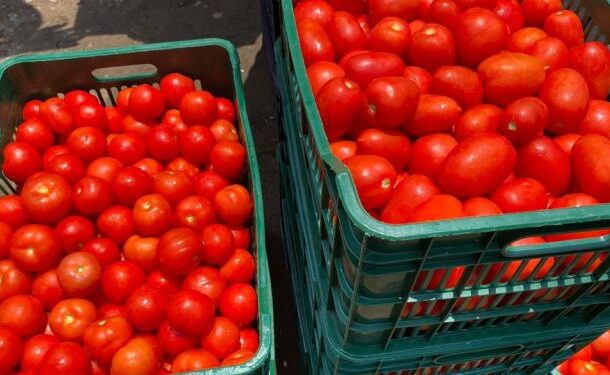
The Head of Protocol at the Ministry of Food and Agriculture, Justice Quarm, has acknowledged that the ban on tomato imports from Burkina Faso will significantly affect Ghana’s food supply and prices.
Speaking on Adom FM’s Dwaso Nsem, Mr. Quarm noted that the situation is not new, recalling a similar disruption between November and December 2024, when restrictions from Burkina Faso led to a sharp rise in tomato prices across Ghana.
According to him, when the National Democratic Congress administration took office, the Ministry engaged farmer groups to find long-term solutions to the recurring shortages.
He identified key challenges facing local tomato production, including:
- Lack of irrigation systems
- Inadequate funding
- Limited access to modern farming equipment
These constraints, he said, continue to hinder efforts to achieve self-sufficiency.
Mr. Quarm explained that government has supported farmers to boost production, which at one point resulted in a glut of tomatoes, forcing authorities to step in through buffer stock purchases.
However, he pointed out that the variety of tomatoes grown locally remains a major issue, affecting both quality and market demand.
To address this, government has:
- Encouraged the formation of farmer cooperatives
- Initiated plans for a tomato processing plant
- Promoted large-scale production strategies
Despite these measures, he admitted that most interventions are still in progress and have not fully addressed supply gaps.
“The current ban is going to really hit Ghanaians because all the measures the Ministry and government have put in place to boost local tomato production have not yet fully materialised,” he said.
Mr. Quarm added that further steps are being taken, including plans to establish a farm service centre at Afram Plains, where improved tomato and vegetable seedlings will be provided to farmers.
He emphasised that while the long-term goal is to strengthen local production, the immediate impact of the import ban is likely to be felt by consumers through reduced supply and rising prices.
Comments