
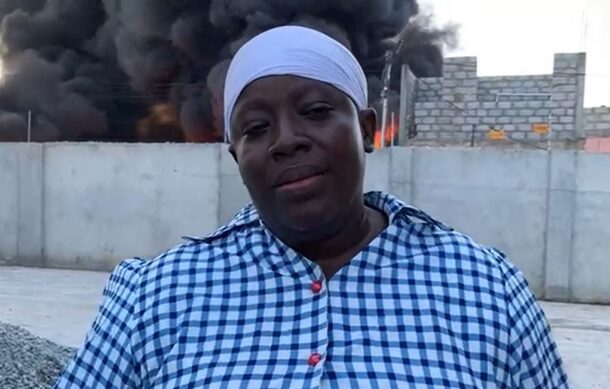
Management of Charkieh Plastics and Packaging Limited, a pioneering recycling company located at the Weija Junction, is reeling from the destruction of its facility after a fierce fire tore through the factory in the early hours of Saturday, November 22.
The inferno, which drew emergency crews from seven different fire stations, levelled the entire plant—demolishing infrastructure built over four decades and reducing specialised recycling machinery to rubble. The factory had been a major player in Ghana’s circular economy, processing large volumes of waste plastics daily.
Speaking to JoyNews, Factory Manager Gloria Amenu struggled to describe the magnitude of the loss, saying the disaster had dealt a blow not only to the business but to hundreds of employees whose lives are tied to the company’s operations.
“A Legacy Gone Overnight” — Manager Laments End of an Era
To Ms. Amenu, Charkieh Plastics represented more than a manufacturing plant; it stood as a landmark in the local industrial landscape.
“It’s not easy at all for us because this is a factory that we’ve built up almost 40 years ago. And then we have workers who have worked here for as long as 33 years. And we were the first factory to have a ‘24-hour economy’ 10 years ago,” she recalled.
The facility was one of the first to run around the clock, significantly contributing to employment and production in the Weija area. Its long-serving workforce, some with over three decades of service, now face an abrupt end to what had felt like a permanent home.
Specialised Machinery Lost: “The Cost Is Beyond Imagination”
A major portion of the company’s losses stems from the destruction of its high-capacity processing equipment used to clean, disinfect, and recycle waste plastics before transporting them to Jamestown for final manufacturing.
Ms. Amenu confirmed that eight core machines were completely destroyed.
“It’s beyond imagination because this is a factory that we have almost six washing machines and two recycling machines,” she said.
These machines formed the backbone of the company’s operation:
Destroyed Equipment:
- 6 industrial washing machines
- 2 industrial recycling machines
The factory’s final assembly point at Jamestown, which produced about 300 finished units daily, has now come to a total standstill.
The cost of replacing these machines, she noted, is overwhelming.
“I can’t state when you can buy it. It’s a very heartbreaking situation,” she added.
Workers Left Jobless and Homeless
Beyond the machinery and structures, the fire has plunged many employees into an immediate social crisis. Charkieh Plastics not only provided jobs but also accommodation for some of its long-term staff.
“We have a lot of workers working with us. So you can see the impact, the effect that it’s going to have,” Ms. Amenu said. “We have a place for the workers to sleep,” she added, revealing that many employees have now lost both their source of income and their homes.
The disaster has created a dual emergency—economic losses for the company and a humanitarian challenge for displaced workers.
Comments