
AGI warns power instability is undermining Ghana’s industrial growth
Ghana’s manufacturing sector is coming under renewed pressure as the Association of Ghana Industries (AGI) warns that recent power disruptions are exposing structural weaknesses in the country’s industrial production systems, raising fresh concerns about resilience in an already high-cost operating environment.
The Association says energy has now shifted from being a routine cost input to a major constraint on industrial growth, directly influencing output, investment decisions, and competitiveness across key manufacturing sectors.
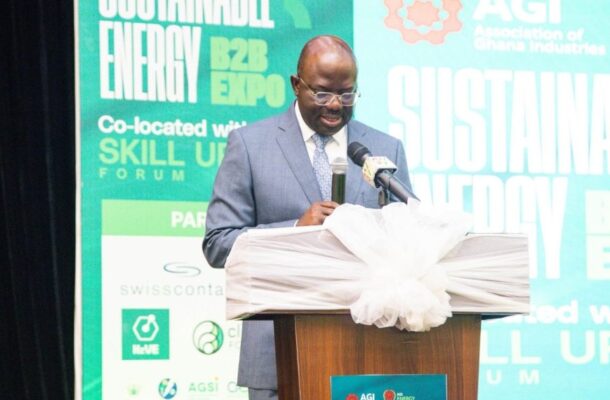
Speaking at the Sustainable Energy B2B Expo 2026 under the theme “Powering Industry through Sustainable Energy,” AGI President Dr. Pharm. Kofi Nsiah-Poku said recurring energy challenges highlight the urgent need to rethink Ghana’s energy framework to support long-term industrial transformation.
He cautioned that manufacturers are increasingly facing pressure from rising production costs as well as stricter global sustainability requirements.
“Energy remains the lifeblood of industrial growth. Without reliable, affordable and sustainable power, industries cannot expand and businesses cannot compete effectively,” he said.
Dr. Nsiah-Poku further noted that Ghana’s industrial ambitions, including the push toward a 24-hour economy, could be undermined without a stable and uninterrupted power supply.
“Ghana’s ambition of building a strong industrial economy and sustaining a 24-hour economy cannot be achieved without stable and uninterrupted power supply,” he stressed.
He added that sustainable energy should no longer be treated as a side issue in development planning but must become central to national industrial strategy.
“Sustainable energy can no longer be treated as an alternative discussion on the sidelines of development. It must become central to our industrial strategy,” he stated.
He also highlighted AGI’s Energy Service Centre as a practical initiative designed to support businesses with energy efficiency solutions and renewable energy integration, describing it as part of efforts to align sustainability with profitability.
For his part, GIZ Cluster Coordinator for Energy and Climate, Gunnar Wegner, said the energy transition is fundamentally about competitiveness, noting that renewable energy adoption can shield businesses from rising fuel costs and global price volatility.
He likened the shift to renewable energy to “moving into your own house,” where firms gain greater control over long-term energy expenses.
Wegner added that private sector participation is essential to accelerating the energy transition, as renewable investments offer both cost efficiency and environmental benefits.
The Expo brought together partners including GIZ, Swisscontact, UN Global Compact Network Ghana, ClimateWorks Foundation, Catalonia Trade & Investment, AHK Ghana, and the Energy Commission, with discussions focusing on financing, innovation, collaboration, and policy support.
Participants also engaged in exhibitions and networking sessions aimed at connecting businesses with sustainable energy solutions, reinforcing calls for cleaner and more efficient industrial energy systems in Ghana.














Comments (0)