
Death toll hits 30 in Accra, Central Region floods
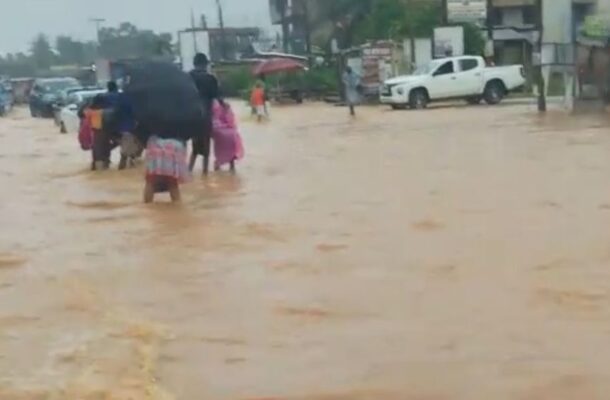
The devastating floods triggered by days of torrential rainfall have claimed at least 30 lives across the Greater Accra and Central regions, with tens of thousands displaced and dozens of buildings collapsing, as the government moves to respond to one of Ghana’s worst flood disasters in recent years.
Addressing Parliament on Tuesday, June 30, 2026, Interior Minister Muntaka Mohammed-Mubarak painted a grim picture of the destruction caused by the floods, revealing that the humanitarian crisis extends far beyond Accra and now affects several regions across the country.
According to the Minister, 12 people lost their lives in the Greater Accra Region, while 18 others died in the Central Region, bringing the confirmed death toll to 30.
The Minister explained that approximately 13 hours of continuous torrential rainfall resulted in both flash floods and riverine flooding that overwhelmed drainage systems and inundated communities throughout the Greater Accra Region.
He disclosed that the National Disaster Management Organisation’s (NADMO) Emergency Operations Centre received more than 1,200 distress calls during the emergency, forcing authorities to issue shelter-in-place advisories while simultaneously deploying rescue and evacuation teams across the capital.
Preliminary assessments by the government indicate that 38,802 people have been displaced by the flooding in Greater Accra alone.
The floods affected 7,761 households, while seven people remain missing as search and rescue operations continue.
Among the hardest-hit districts was Korle Klottey, where about 6,500 residents were displaced, making it the most severely affected district in the region.
Other heavily impacted areas included Tema Metropolitan, Tema West, Ayawaso Central, Ga West, Ga South, Weija-Gbawe, Ga East, Adenta, Ledzokuku, Okaikwei North and several other municipalities.
Ga East recorded the highest number of fatalities in Greater Accra, with five deaths, while Ayawaso Central and Tema Metropolitan each recorded three fatalities. Ledzokuku recorded one death.
Beyond Accra, the Central Region also suffered significant devastation.
According to the Interior Minister, 18 people died across several districts following floods and building collapses triggered by the heavy rains.
Cape Coast recorded the highest number of fatalities, with six deaths, including five people killed in building collapses and one person who drowned.
Mfantseman recorded three deaths, while Upper Denkyira West also lost three people through drowning.
Upper Denkyira East recorded two drowning deaths, while Gomoa Central, Twifo Atti Morkwa and Agona West each recorded fatalities.
The Minister further disclosed that the floods caused the collapse of 58 buildings across the Central Region.
Cape Coast Metropolitan alone accounted for 20 collapsed houses, followed by Agona East and Assin North with seven collapsed structures each.
Other affected districts included Twifo Hemang Lower Denkyira, Mfantseman, Gomoa East, Gomoa West, Assin South, Awutu Ofankor, Abura-Asebu-Kwamankese and Effutu.
The impact of the flooding has not been limited to Greater Accra and the Central Region.
The Interior Minister informed Parliament that several communities in the Volta Region have also been affected by rising water levels.
Communities within Keta, Anloga, Ketu South, Ketu North, South Tongu, Central Tongu, North Tongu, Akatsi South, Adaklu, Agotime-Ziope and Ho Municipality have all reported flooding, with assessments still ongoing.
Affected communities include Aborlove Nolopi, Anyako, Seva, Kome, Akpe, Dzodze, Battor, Mepe, Adidome, Kpetoe, Torda and several others spread across the region.
The latest briefing marks the most comprehensive official account of the disaster since the floods struck and underscores the scale of the humanitarian challenge now confronting government.
The disaster followed hours of intense rainfall that submerged major roads, homes, markets, schools and businesses across Accra, disrupting transportation and economic activities while forcing thousands of residents to seek temporary shelter.
President John Dramani Mahama has since directed the release of GH¢300 million to support emergency relief operations and flood mitigation measures.
Government has also announced plans to intensify rescue operations, provide humanitarian assistance to displaced families and implement long-term interventions aimed at reducing the country’s vulnerability to recurring floods.





Popular News
No trending posts found.