
Fisheries closed season gains strong backing from Ghanaian fishers – EJF assessment
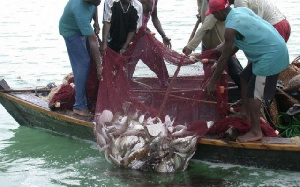
An environmental impact assessment of Ghana’s fishing closed season regime has recorded strong approval from fishers and key stakeholders in major coastal communities across the country.
The three-year study, conducted since 2023 by the UK-based Environmental Justice Foundation (EJF), covered eight coastal towns including Axim, Sekondi, Shama, Elmina, Apam, Bortianor, Tema, and Keta.
According to the findings, more than 80 per cent of fishers interviewed demonstrated an understanding of the scientific rationale behind the closed season policy, which is aimed at supporting the recovery of fish stocks.
The assessment involved 120 fishers who participated in biological monitoring activities during the closed season. Many respondents reportedly said their involvement in the process gave them a sense of pride in contributing to the restoration of Ghana’s marine resources.
The report also noted that nearly half of the fishers trained as citizen scientists expressed increased trust in fisheries regulators. In addition, 92 per cent showed strong scientific understanding of the process, while 85 per cent indicated willingness to take part in future training programmes.
EJF’s Science and Research Manager in Ghana, Dr Edna Quansah, explained that participating fishers were engaged in various aspects of the monitoring process, including sourcing fish for analysis, measuring and gutting samples, data entry, and community education on the closed season.
She noted that most participants were involved in measuring and processing fish samples, which allowed them to directly observe biological indicators linked to fish stock recovery.
“Our research and assessment show clearly that the closed season is scientifically necessary and strongly supported by fishing communities themselves,” Dr Quansah said.
She added that greater community involvement in policy design, implementation, and monitoring would strengthen compliance and improve outcomes, alongside fair and consistent enforcement.
During engagements with fishing communities, fishers also made several recommendations to improve the effectiveness of the policy. These included early and clear communication of closed season dates, expanded public education through local media and community outreach, and increased stakeholder engagement.
Fishers further urged government to provide soft loans during the closed season to ease financial hardship and called for stronger enforcement against illegal fishing activities to ensure the ecological benefits of the policy are fully realised.
Ghana’s marine fisheries sector supports the livelihoods of about 10 per cent of the population and contributes significantly to national food security, accounting for about 80 per cent of total fish production.
However, concerns over overfishing remain widespread, particularly in the small pelagic fishery, which includes species such as sardinella and chub mackerel—commonly referred to as the “people’s fish”.
By 2020, nearly all sardinella landed by industrial trawl fleets were below the legally permitted minimum size, raising alarm over the sustainability of the fishery, which is considered vital to coastal livelihoods.
The closed season policy was first introduced for industrial trawl vessels in 2016 and later extended to all fishing fleets in 2019. In 2025 and 2026, the Ministry of Fisheries and Aquaculture Development granted exemptions for artisanal canoe fishers, while encouraging compliance with other traditional conservation measures such as fishing holidays.














Comments (0)