















Ghana’s Mahama addresses Jamaica’s parliament during state visit
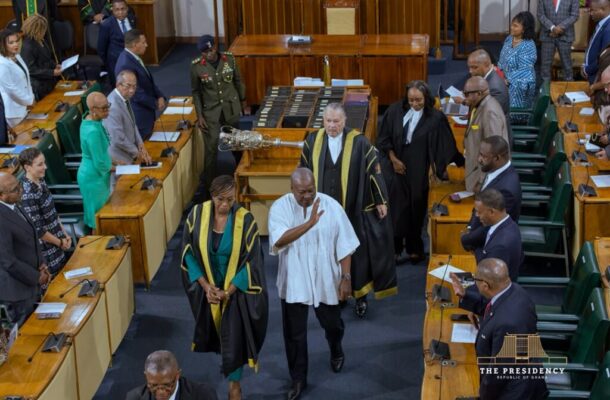
Ghanaian President John Dramani Mahama has addressed a joint sitting of Jamaica’s House of Representatives and Senate in Kingston, using the occasion to highlight the shared history of the two nations and their campaign for reparatory justice.
Mahama, who is on a state visit to Jamaica, was formally received in the chamber by the Speaker of the House of Representatives, Juliet Holness, and the President of the Senate, Thomas Tavares-Finson. Jamaican Prime Minister Andrew Michael Holness was also present.
The address took place as Jamaica marked Emancipation Day and its 64th Anniversary Independence Day Celebration.
Mahama said Ghana stood alongside Jamaica in celebrating “the remarkable journey of a proud people whose courage, creativity and resilience continued to inspire the whole of Africa, the Caribbean and the global African diaspora”.
He also recalled that Ghana was among the first countries to recognise Jamaica after it became independent in 1962.
“Emancipation Day and Independence Day are not simply national celebrations, they are endurance symbols of humanity’s determination to overcome oppression and reclaim dignity,” the President said.
“They remind us that even in the darkest chapters of history, nothing can extinguish the human spirit. The story of Jamaica is in many respects the story of Africa.”
The Ghanaian leader traced that story to the great civilisations of Africa, including the Empires of Ghana, Mali, Songai and Great Zimbabwe, as well as Buganda, Ashanti, Mossi, Benin and Ile-Ife.
He said millions of Africans were later taken across the Atlantic, where they endured the Middle Passage and the brutality of enslavement. Despite those experiences, he said, African communities in the Americas preserved their identity, faith, traditions and humanity.
Mahama said generations resisted oppression and ensured that their descendants would inherit hope rather than despair. He referred to the Maroon communities in Jamaica and the liberation movements across Africa as evidence that the spirit of resistance had endured.
That resistance, he said, eventually contributed to the emergence of free nations determined to control their own futures.
“Today we honour the enslaved men and women whose labour enriched empires while their humanity was denied them. We honour those who resisted injustice. We honour those who fought for emancipation, self-determination and national liberation,” the President said.
“And we honour the generations whose sacrifice secured the freedoms that we enjoy today. Their courage reminds us that freedom is never given on a silver platter. It is earned through sacrifice. It is sustained by vigilance and strengthened by unity.”
Mahama urged Ghana and Jamaica to confront their shared history openly, arguing that historical truth had to be acknowledged before reconciliation, justice and mutual respect could be achieved.
He said the transatlantic slave trade and the racialised chattel enslavement of Africans had been reaffirmed by the United Nations General Assembly as a grievous crime against humanity. The effects of that crime, he added, had continued beyond abolition and still influenced inequality and exclusion around the world.
The President called for continued international discussion on reparatory justice, saying the campaign was not driven by hostility or a wish to reopen old wounds. Instead, he said, it was based on truth, accountability, reconciliation and healing.
“In this regard to meet me to express Ghana’s profound appreciation to the government and people of Jamaica for your unwavering support to Ghana’s initiative at the United Nations, which culminated in the adoption of Resolution A.R.E.S./18/250 and for your invulnerable contribution to the Accra Next Steps Conference on Reparatory Justice.”
He praised Jamaica’s long-standing leadership on the issue and said the two countries were working to ensure that the descendants of those affected by slavery were not forgotten or denied a role in shaping a fairer world.
“Our advocacy is ultimately about hope, hope that our future generations will inherit a world in which historical truth is acknowledged. Human dignity is upheld and justice becomes the foundation for lasting reconciliation,” he said.
“And that is the vision that continues to unite Ghana and Jamaica. It is a vision worthy of our ancestors. It is a vision to which we remain unwaveringly committed.”
Mahama also repeated his support for the Jamaican prime minister, who was soon to submit a petition on slavery to King Charles III of the United Kingdom.
While insisting that the injustices of history must not be forgotten, he said they should not be allowed to imprison future generations.
The history of people of African descent, Mahama said, was not solely one of suffering. It was also a record of resilience, achievement and excellence, including advances in knowledge, resistance leaders who challenged oppression, scientific and technological innovation, artistic contributions and statesmen and women who inspired nations to pursue freedom and self-determination.





Popular News
No trending posts found.