MIIF leads Inter-Agency Drive to curb mineral royalty leakages
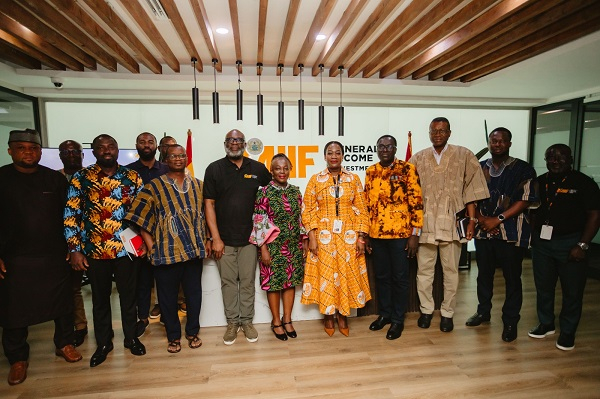
The Minerals Income Investment Fund (MIIF), in partnership with key institutions in Ghana’s extractive sector, has reactivated an inter-agency committee to improve the monitoring, verification, and collection of mineral royalties and other revenues due the state.
The committee brings together representatives from MIIF, the Ghana Revenue Authority, the Minerals Commission, the Ghana Standards Authority, the Minerals Development Fund, the Economic and Organised Crime Office, GoldBod, the Environmental Protection Authority, and the Ministry of Lands and Natural Resources.
The committee is chaired by Dr Martin Yamborigya, Acting Commissioner of the Domestic Tax Revenue Division of the Ghana Revenue Authority.
The inaugural meeting of the reconstituted committee took place on Friday, May 8, 2026, at the MIIF boardroom in Accra, where members deliberated on improving coordination among institutions responsible for royalty tracking, licensing oversight, production reporting, and regulatory compliance in the mining sector.
MIIF Chief Executive Officer, Mrs Nelson, explained that the committee’s revival became necessary after a period of inactivity caused by institutional transitions, which had created gaps in coordination and enforcement.
She noted that the renewed framework is expected to address challenges such as undeclared mineral production, revenue leakages, and weak regulatory monitoring, particularly within parts of the small-scale mining sector.
Mrs Nelson also emphasised the importance of mineral royalties to Ghana’s economy, describing them as a vital source of funding for national development projects and infrastructure.
She further highlighted recent reforms to Ghana’s royalty regime, which shifted from a fixed-rate system to a sliding-scale structure. According to her, combined with strong global gold prices, the changes are expected to significantly boost government revenue.
Dr Yamborigya acknowledged ongoing challenges in domestic revenue mobilisation, particularly outside large-scale mining operations, noting that sectors such as quarrying, salt production, and other mineral activities often receive limited oversight.
The committee reviewed draft terms of reference outlining its mandate, governance structure, and operational procedures. Key discussions focused on improving inter-agency data sharing, strengthening monitoring systems, and ensuring consistent reporting on production volumes and royalty payments.
Members also proposed the creation of a comprehensive database of mining operators and mineral rights holders to enhance tracking of production and royalty obligations.
Funding and sustainability of the committee’s activities were also discussed, including proposals for cost-sharing arrangements among member institutions to support field inspections and monitoring exercises.
Participants stressed the need for stronger collaboration in tackling illegal mining and ensuring that all eligible operators contribute appropriately to national revenue.
Officials from the Ghana Revenue Authority indicated that previous collaborative efforts had yielded positive results and expressed confidence that renewed coordination would improve compliance and revenue assurance.
MIIF clarified that its role will mainly focus on coordination and providing secretariat support, while the broader objective remains safeguarding national revenue and improving accountability in the extractive sector.
At the end of the meeting, members agreed to adopt revised operational guidelines and hold monthly meetings to sustain collaboration and oversight.
They also expressed optimism that enhanced inter-agency cooperation would improve transparency, strengthen royalty administration, and maximise Ghana’s long-term benefits from its mineral resources.











Comments (0)