
Prez Mahama blames Accra flooding on climate shift, choked drains and lawlessness
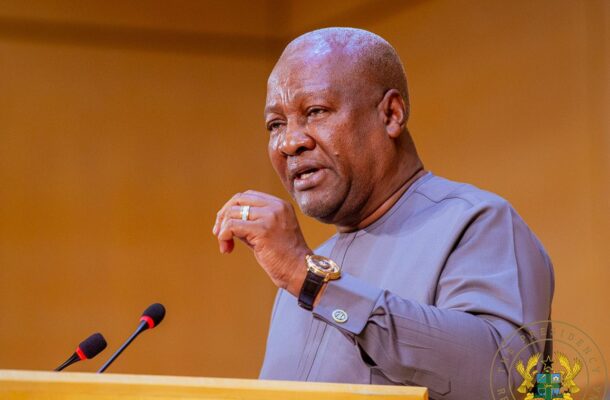
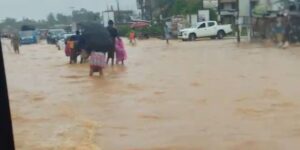
President John Dramani Mahama has pinpointed a convergence of escalating meteorological forces, deteriorating infrastructure and systematic environmental transgression as the root causes of Monday’s catastrophic inundation that left swaths of the capital submerged and at least one resident dead.
Following an aerial reconnaissance of the devastated neighbourhoods on June 29, Mahama laid out a diagnosis that extends beyond simple rainfall tallies to encompass systemic failures spanning nature, engineering and human conduct.
The statistical evidence is stark.
Accra received 140 millimetres of precipitation in the span of a single day — more than double the 56 millimetres that typically constitutes a severe rainfall event in any given year.
That volume overwhelmed drainage infrastructure designed for substantially lighter loads.
But the problem runs deeper than one exceptional storm. The Ghana Meteorological Agency’s historical rainfall data reveals an ominous trajectory.
June precipitation totals have surged from 85 millimetres in 2024 to 172 millimetres in 2025 and 333 millimetres in 2026 — a tripling of moisture delivery over comparable calendar periods.
The cumulative effect leaves drainage channels perpetually saturated, robbing them of the recovery time necessary to clear before the next deluge arrives.
Geography compounds the predicament. Accra sits wedged between the Akwapim mountain spine and the Atlantic shoreline — topography that creates natural waterflow patterns evolved over millennia.
Yet urban sprawl has systematically obstructed these pathways.
Rising populations and construction that pays scant regard to planning protocols have narrowed or completely blocked the channels through which stormwater must flow toward the sea, creating catastrophic bottlenecks in the city’s hydraulic system.
Human behaviour has accelerated the crisis. Residents dump refuse indiscriminately into drainage conduits, choking them with solid waste.
Wetlands — natural shock absorbers that would historically have dispersed floodwaters — have been converted into illegal dumping repositories or squatter settlements.
Perhaps most perversely, unscrupulous actors have created unauthorised dumping sites, later monetised by selling the contaminated land to developers — a scheme that transforms environmental hazards into illicit profit centres while worsening flooding vulnerability for entire communities.
Mahama acknowledged the policy dilemma that has long paralysed governmental response. Addressing the crisis demands aggressive intervention: clearing obstructed waterways, demolishing illegal structures erected atop natural drainage paths, reclaiming wetlands from human encroachment.
Yet such enforcement attracts fierce criticism, with those affected by demolition characterising it as governmental cruelty rather than necessary public health measure.
The President argued forcefully that such criticism reflects a failure to grasp causality. Individual choices — blocking a waterway, dumping in a drain, erecting a structure on a floodplain — ripple outward, ultimately submerging entire neighbourhoods and claiming lives.
Inaction in the name of avoiding confrontation merely redistributes suffering, concentrating it upon the most vulnerable populations.
Mahama concluded that remediation requires a two-pronged assault: engineering solutions to restore and expand drainage capacity, paired with rigorous enforcement of planning codes and environmental regulations to prevent future obstruction. Neither alone suffices; both must advance in tandem.




Popular News
No trending posts found.