
Monday’s rains among highest in several years — Mahama
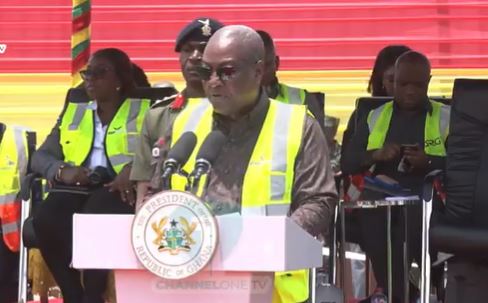
President John Dramani Mahama has characterised Monday’s precipitation event as belonging to the pantheon of exceptional rainfall years — a meteorological occurrence so severe that it has drawn comparisons to the most formidable storms the capital has weathered in recent memory.
Following a helicopter survey of submerged neighbourhoods on June 29, Mahama placed the event within statistical context that underscores both its singular intensity and the broader climatic trajectory threatening the city’s adaptive capacity.
The numbers tell a story of exceptional force. Accra absorbed 140 millimetres of water in the space of a single calendar day — nearly triple the 56-millimetre maximum that characterised the heaviest rainfall episodes of the prior year.
That deluge represented an atmospheric delivery so massive that the city’s engineered systems simply could not accommodate the volume.
Yet the more alarming pattern emerges when viewed across years rather than hours. June precipitation totals have escalated from 85 millimetres in 2024 to 172 millimetres in 2025, reaching 333 millimetres in the current year — an acceleration suggesting that what occurred Monday may represent the new normal rather than an exceptional outlier.
The President identified a secondary mechanism amplifying the damage: drainage infrastructure designed for historical rainfall patterns lacks the recovery interval necessary to clear itself between successive downpours.
With moisture arriving with increasing frequency, the city’s stormwater channels exist in a perpetual state of saturation, losing their capacity to absorb additional precipitation.
Urban development has exacerbated this hydraulic vulnerability. Natural watercourses that once moved precipitation efficiently from higher elevations toward the sea have been progressively constricted by construction along their banks.
Developers have encroached upon these pathways, narrowing them or diverting them entirely, creating bottlenecks that transform manageable volumes into destructive surges.
Human malfeasance has compounded the engineering challenge. Refuse dumped into drainage conduits clogs them with sediment and solid waste.
Wetlands — ecological systems evolved over millennia to absorb and disperse floodwaters — have been systematically converted into unauthorised disposal repositories or informal settlements.
Scavengers have monetised the conversion, purchasing contaminated land previously used as dumping sites and selling it for development — a scheme that both removes absorptive capacity and concentrates vulnerable populations atop hazardous terrain.
Mahama stressed that genuine remediation demands simultaneous progress on two fronts: engineering solutions to restore and expand drainage capacity, paired with uncompromising enforcement of planning and environmental statutes.
The President acknowledged that such enforcement remains politically costly — residents resist demolition of illegal structures, characterising state action as oppressive.
Yet Mahama rejected that framing as myopic. Individual choices to block waterways or erect structures on floodplains create cascading consequences that ultimately submerge entire communities.
Refusing to enforce regulations in the name of avoiding controversy simply redistributes suffering, concentrating it upon the most defenceless populations unable to purchase their way to safety.





Popular News
No trending posts found.