
Attracting Children through Custom Packaging Boxes
Retail display box packaging has both a logistical and a marketing function in protecting the product throughout the distribution channel and as a medium for conveying attractive messages or images to draw your consumers’ attention. The Legacy Printing believes that this often-undervalued marketing tool has the power to communicate product benefits, change consumer beliefs and encourage the purchase instantly.
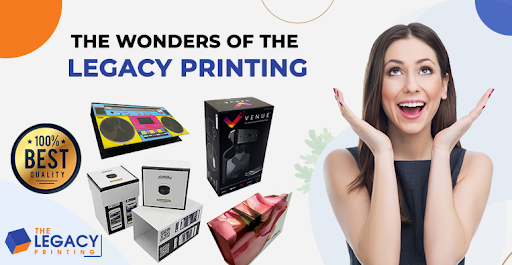
Packaging boxes communicate through tactility, where their size, shape, weight, and texture play essential roles. Likewise, custom packaging can differentiate among products at the point of purchase and can provide a tangible advantage over ephemeral messages transmitted by the media. As a product-related attribute, the packaging is considered an irrelevant cue. The packaging company suggests that consumers use such extrinsic cues to evaluate products in the following circumstances, when
(i) The brand is unfamiliar (e.g., uncertainty),
(ii) Consumer does not have enough opportunities to evaluate intrinsic cues, and
(iii) Consumers cannot readily evaluate intrinsic attributes.
However, it is absolutely vital to choose the right amount and type of information in packaging. Failing to create a balance can harm consumers’ perceptions of products’ ability to deliver the desired benefit. Does the packaging company further suggest considering what attracts the children? How can a packaging box be a communicative vehicle? – before designing the cookie packaging or retail display box packaging for children.
One of the best product strategies for children is to create products based on kid‐ness. This strategy is used by many leading brands while designing potato chip bags and cereal boxes. Another innovation is to associate children’s products with playfulness and fun and use the surprise dimension. The custom packaging design, or the ‘salesman on the shelf,’ must follow certain principles when targeting children.
Firstly, According to The Legacy Printing, it is crucial to understand the market and realize that the children’s market is not homogenous: their purchase priorities change with age, gender, social trends, and peer perceptions. It is also essential to use the target’s language by combining colors, typography, graphic symbols, shapes, and characters. This will enable the targeted children to relate to the product and feel it is communicating to them.
This last result can be effectively achieved if we can also capitalize on the power of media, namely through high‐visibility licensed characters, for example, Shrek, The Incredibles, SpongeBob SquarePants, and Scooby-Doo (the list is not exhaustive). If you are targeted girls, you can always go for The Frozen Sisters, Power Puff Girls, Nella and of course, there has always been Barbie – every girl’s favorite. Additionally, it is essential to exploit the entertainment potential of cookie packaging, such as the common inclusion of games on the back of cookie boxes that children can play with while eating.
Finally, given children’s limitations in processing information, it is crucial to avoid information overload and use visual aids or symbols as an effective way to highlight significant product benefits and attract attention to the package.
Packaging Design, Evaluation, and Attention to Packaging
Package design comprises functional and visual attributes. It can substantially impact attention to the brand and brand choice, particularly in the case of unfamiliar brands with high levels of experiential benefits, such as chocolates. Children find food and toys visually more attractive, well packaged, and better promoted, especially if the packaging box has a die-cut window.
Packaging Design and Product Evaluation
More appealing packaging positively impacts the product evaluation among adults. Emotions evoked by an adorable packaging box are stronger and more favorable than those prompted by ordinary packaging.
Packaging Design and Perceived Healthiness
Most children do not read products’ nutritional information (unless they are bored while eating them) and do not make choices based on this information. However, within this 10–14 age group, they exhibit a considerable knowledge of nutrition and know that fruit and vegetables are healthy. A few brands suggest that the parents always look at the nutritional levels; therefore, it is best to write the ingredients and dietary levels clearly on the cookie boxes.
Packaging and Purchase Intention
Extrinsic product attributes, such as packaging as product labeling, have a particular role in children’s purchasing behavior. This is evident in communication at the point of purchase when consumers have not thought about the product before entering the store. The packaging box becomes a critical factor in the consumer decision‐making process as it communicates when they are deciding in the store.
Color Characteristics and their Role in Packaging
Children have limited cognitive capacities. Therefore, they principally use visual attributes when assessing a product. And it is also known that children are sensitive to the colors of packaging. Color is generally defined according to three dimensions, i.e., shade (or tone), light (clarity), and saturation (chromatic purity). This three-dimensional nature of color leads to inevitable complications in packaging and marketing. Minor variations at one of these levels may lead to differing results.
Effects of Color on Activation and Attention
According to the experts, warm colors have a stimulating power that cold colors do not have. The ability of colors to attract more or less attention is also considered on several occasions in a branding and packaging context, in particular showing a general superiority of messages in color over messages in black and white, where distinction differs depending on the level of effectiveness desired. Variations in legibility where two colors are used together are also noted (black on yellow prevailing, for example, over the green-orange combination).
According to the product categories on the shelves, packaging in an intense color is always better at attracting consumer attention than lighter color packaging. More specifically, some colors, like yellow, red, and blue, are evident on shelves, thus justifying a practice that leads to shelves being packed with bright colors that hide products more often of a neutral flavor. The experts further believe that the colors and shape of packaging directly influence your brand’s image. It has been pointed out that light color is used to influence children’s choices in stores.
Color and Sensory Perception
The colors are highly associated with the perceptions of flavor, olfactory, and other sensations. With particular regard to taste, colors bring about flavor sensations (red can be used to stimulate feelings of solid flavor, green makes the children think that the food is spicy and sour, pink speaks for sweet and sugary, yellow for spicy and acidic, and orange for peppery and spicy). For young people, the color of the food arouses a greater or lesser degree of curiosity from the child.
For example, the purple color of fruit jelly leads children to say that it is sugarier than a green fruit jelly; this perception is linked to the fact that, through learning, the child associates the color green to the notion of “not ripe,” therefore not sugary. The positive influence of color in children’s choice for cookies has demonstrated that the smell and color of a food product influence children’s perception of its sweetness. Therefore, while designing the packaging for children, it is best to understand the color associations.













Comments (0)