
Mahama orders CJ to fast track ORAL cases
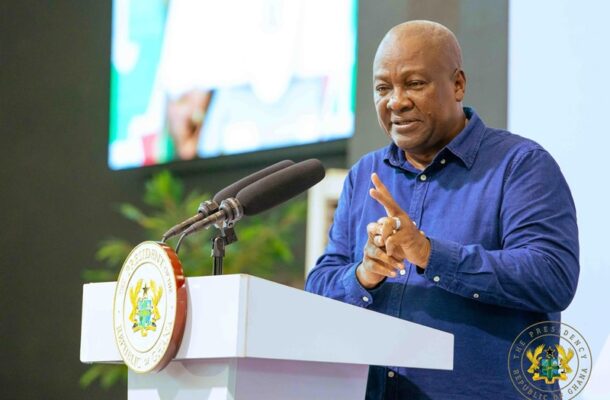
President John Dramani Mahama has revealed that he has engaged the Chief Justice, Paul Baffoe-Bonnie, to ensure that cases arising from the government’s flagship anti-corruption programme, Operation Recover All Loot (ORAL), are expedited in the courts, as mounting public pressure and political criticism continue to weigh heavily on the initiative.
Speaking during a town hall meeting in Koforidua, the Eastern Regional capital as part of his “Resetting Ghana” tour, the President expressed frustration over delays in prosecuting corruption-related cases linked to former government officials, insisting that swift justice is critical to fulfilling his administration’s promise of accountability.
However, he was quick to acknowledge the constitutional limits of his authority, stressing that he cannot interfere directly with judicial processes despite ongoing engagements with the judiciary.
“I want the cases to be fast-tracked, but I cannot force the judges. We have separation of powers. I am the Executive, and they are the Judiciary,” President Mahama stated, adding that discussions with the Chief Justice were aimed at ensuring efficiency rather than exerting pressure on the courts.
The President disclosed that currently, about seven ORAL-related cases are before the courts, with an additional five or six cases expected to be filed soon. He admitted that, personally, he would have preferred a more aggressive approach.
“If I had my way, I would have arrested and jailed all suspects in the ORAL cases, but I swore an oath to uphold the Constitution on January 7, 2025,” he told the gathering.
ORAL And Rising Expectations
The ORAL initiative, launched in December 2024, was a central campaign promise of the ruling National Democratic Congress (NDC), aimed at investigating corruption, recovering looted state assets, and prosecuting individuals implicated in financial misconduct under previous administrations.
The programme initially generated widespread public enthusiasm, particularly among NDC supporters who expected rapid arrests and prosecutions of officials linked to the opposition New Patriotic Party (NPP).
However, more than a year into its implementation, the initiative has come under intense scrutiny due to the slow pace of prosecutions and unreliable data described as junk.
Government communicators, including Felix Kwakye Ofosu, have clarified that ORAL was never intended to bypass due process or rely on extrajudicial measures, emphasizing that all cases must go through investigations, docket preparation, and court proceedings.
Attorney-General Dominic Akuritinga Ayine has also defended the pace, noting that only properly investigated cases with sufficient evidence can secure convictions, and that his office has been reviewing multiple dockets while returning weak cases for further work.
Criticism From All Sides
Despite these explanations, pressure continues to mount. Within the NDC, grassroots supporters have expressed disappointment over the lack of high-profile convictions, with some accusing the legal process of moving too slowly to meet the expectations set during the campaign.
Former Auditor-General Daniel Domelevo added to the concerns when he disclosed that much of the data collected under ORAL consisted of unverified complaints, raising questions about the strength of evidence in some cases.
NDC General Secretary Fifi Kwetey has also warned that some party-affiliated lawyers could be undermining the process through alleged behind-the-scenes dealings, further complicating efforts to deliver results.
On the other side, the NPP has sharply criticised the initiative, describing it as ineffective and politically motivated.
Opposition figures argue that ORAL has failed to secure convictions against any of their members due to a lack of evidence, and have labelled the programme a campaign tool rather than a genuine anti-corruption effort.
Concerns Over Judicial Independence
President Mahama’s remarks about engaging the Chief Justice have sparked fresh debate about judicial independence, with critics questioning whether such interactions could be interpreted as executive pressure on the judiciary.
Legal analysts caution that while administrative collaboration between arms of government is not unusual, any perception of influence over court proceedings could undermine confidence in the justice system.
The President, however, has maintained that his actions respect constitutional boundaries and are intended only to improve efficiency.
Balancing Speed And Due Process
The President reiterated that the democratic framework requires strict adherence to due process, including investigations, preparation of dockets, trials, and appeals where necessary.
He referenced past eras of military rule, noting that while those systems allowed for swift punishment, they often led to abuses.
“We are running a democracy. You are innocent until proven guilty,” he emphasized, urging the public to exercise patience as the legal process unfolds.
The Road Ahead For ORAL
However, as ORAL cases inch through the courts, the government is also considering additional measures to accelerate the process, including the possible establishment of specialised courts and outsourcing aspects of docket preparation to private legal practitioners.














Comments (0)