
Unraveling the Universe’s Enigma: Euclid Telescope’s Launch to Probe the Cosmos
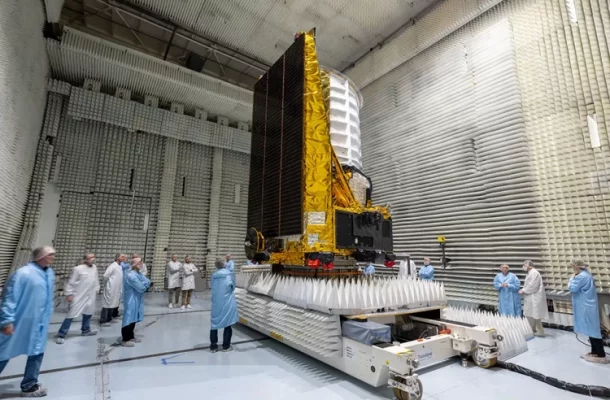
The Euclid telescope, a joint venture between the European Space Agency and NASA, embarks on a mission to unravel the mysteries of dark matter and dark energy.
Join us as we explore the significance of this quest and the ambitious goals of the Euclid mission.
Introduction:
Today marks a monumental step in the pursuit of scientific knowledge as the Euclid telescope, a collaborative effort between the European Space Agency (ESA) and NASA, sets forth on a momentous mission from Florida.
This groundbreaking venture aims to shed light on one of the most profound enigmas in science—what constitutes the fabric of our Universe? Through the creation of a comprehensive 3D map, the Euclid mission endeavors to establish connections between the elusive phenomena known as dark matter and dark energy, which are believed to shape the very essence of our cosmos.
- Delving into the Unknown Dark matter and dark energy have long captivated the minds of scientists and astrophysicists, yet their true nature remains shrouded in obscurity. The Euclid mission arises from the recognition that our understanding of these enigmatic forces is woefully inadequate. These intangible entities exert influence over the formation, structure, and expansion of the Universe, yet their direct detection continues to elude us, leaving crucial gaps in our comprehension of the cosmos.
- Pursuing Origins and Unveiling the Universe’s Secrets Professor Isobel Hook highlights the profound implications of this knowledge gap, emphasizing that it hinders our ability to unravel the mysteries surrounding our origins. With the launch of the €1.4 billion Euclid telescope, scientists embark on an ambitious journey to overcome these limitations and illuminate the fundamental building blocks of the Universe.
- A Stellar Collaboration The Euclid mission epitomizes the power of international collaboration and knowledge sharing. While primarily led by the ESA, this ambitious endeavor incorporates invaluable scientific and engineering expertise from NASA. By leveraging the combined capabilities and resources of these renowned space agencies, the mission is poised to unlock unprecedented insights into the cosmic realm.
- Charting New Territories Following its launch, the Euclid telescope will traverse a vast expanse of space, positioning itself approximately 1.5 million kilometers from Earth, on the opposite side of the Sun. From this strategic observation point, Euclid will meticulously capture data, constructing a comprehensive 3D map of the Universe. This unprecedented cartography will enable scientists to study the intricate interplay between dark matter, dark energy, and the cosmic structures they influence.
- Illuminating the Cosmos The Euclid mission’s significance extends far beyond the realm of scientific curiosity. Its findings hold the potential to revolutionize our understanding of the Universe and redefine our place within it. By peering into the cosmic depths, Euclid aims to address one of the most profound questions that have puzzled humanity for ages—what lies at the core of our existence?
Conclusion:
As the Euclid telescope embarks on its cosmic odyssey, humanity stands on the precipice of enlightenment.
This joint venture between the ESA and NASA represents a momentous leap forward in our quest to comprehend the mysteries of dark matter and dark energy.
Through its ambitious mission to create a comprehensive 3D map of the cosmos, Euclid will pave the way for unprecedented discoveries, propelling humanity toward a deeper understanding of our Universe.
With each new revelation, we inch closer to unraveling the intricate tapestry of our existence and gaining invaluable insights into the fundamental nature of reality itself.






Popular News
No trending posts found.