
Damang lease headed to parliament as gov’t defends continued operations
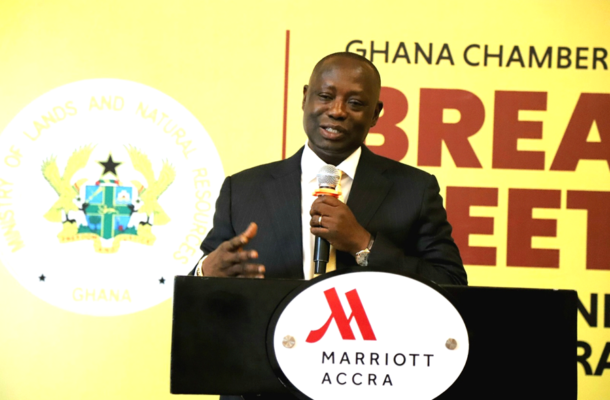
Government will soon submit the lease agreement governing operations of Damang Gold Mine to parliament for ratification, while defending the mine’s continued operation following its takeover from Gold Fields despite the absence of parliamentary approval.
The Minister of Lands and Natural Resources, Emmanuel Armah-Kofi Buah, said suspending operations pending ratification was not a viable option given the thousands of jobs and economic activities linked to the mine.
The issue has emerged as one of the most closely-watched developments in the country’s mining sector, raising questions about regulatory certainty, parliamentary oversight and management of strategic mineral assets following the mine’s takeover by Engineers and Planners (E&P) after Gold Fields’ lease expired.
Under the country’s mining laws, mineral rights and mining leases are subject to parliamentary ratification.
Speaking in an interview with Business & Financial Times (B&FT) on the sidelines of a meeting with the Ghana Chamber of Mines in Accra, Mr. Buah said the Damang agreement forms part of a broader package of outstanding mining-related agreements government intends presenting to lawmakers.
Aviation industry reports
“We are very shortly going to parliament with a lot of ratifications, not only with Damang but also other outstanding ratifications,” he said.
According to the minister, government has already engaged parliament’s leadership and submitted a list of agreements awaiting approval. “We have given them a list of ratifications that we intend sending to parliament,” he added.
Mr. Buah argued that halting operations while awaiting parliamentary approval would have had serious consequences for workers, contractors and host communities whose livelihoods depend on the mine.
Newspapers
He said the authorities relied on powers available under the existing regulatory framework to ensure operations continued while the ratification process was being completed.
“It is a practice in the industry that even as we work on those ratifications, by the power vested in the authority of the Minerals Commission, we can make sure benefits to the people of Ghana are not stopped,” he said.
The upcoming parliamentary submission is expected to provide lawmakers with an opportunity to scrutinise legal and commercial arrangements underpinning the mine’s continued operation.
It will be recalled that the Vice-President in charge of Research at the IMANI Centre for Policy and Education and founder of mPedigree, Bright Simons, recently questioned legality of the mine’s operations before parliamentary ratification.
“The law is clear. Until parliament ratifies a lease, the gold in any concession belongs to the state and no other company,” Mr. Simons wrote on social media, arguing that E&P has no legal basis to sell gold from the concession pending parliamentary approval.
The comments reignited debate over a longstanding practice in the country’s mining industry, where operations have often commenced before parliament completes the ratification process.
Responding to the controversy, resource governance expert and Co-Chair of the Ghana Extractive Industries Transparency Initiative (GHEITI), Dr. Steve Manteaw, said the concerns raised are legitimate but must be viewed within the sector’s historical and legal context.
According to him, neither the 1992 Constitution nor the Minerals and Mining Act, 2006 (Act 703) stipulates a timeline within which parliament must ratify mining leases, nor do they place responsibility for securing ratification on mining companies.
“As a result, many large-scale mining companies in Ghana have historically operated for years – and in some cases decades – before obtaining parliamentary ratification of their leases,” he said.
Dr. Manteaw explained that the established industry practice has been guided by Section 13 of Act 703, which provides the framework for granting mineral rights. Once the Minerals Commission recommends approval and the minister grants the mineral right, the holder is entitled to enter the concession and commence operations.
He maintained that all procedures required under the law were followed in the Damang concession’s case and documentation exists to support this position.
“The presence of E&P and Damang Gold Mine Limited on the concession is therefore well grounded in law,” he said.
Dr. Manteaw further argued that the arrangement entered into by government was necessary to prevent a shutdown of the mine, safeguard jobs and preserve state revenues while the ratification process is completed.
He also pointed to a 2019 lawsuit challenging the operations of dozens of mining companies whose leases had not been ratified by parliament. Rather than halt their activities or seek recovery of revenues, parliament subsequently ratified those agreements and regularised the situation.
“If we accommodated multinational companies on this score, why not our own indigenous company – especially when a halt in operations would result in loss of jobs and revenues to the state?” he asked.
He said the Damang episode nevertheless highlights a need for reforms, including statutory timelines for parliamentary ratification of mining leases, measures to reduce bureaucratic delays and greater clarity on how companies should operate when approval processes are pending.















Comments (0)