
Afenyo-Markin’s leadership lauded at Osahen Excellence Public Lecture
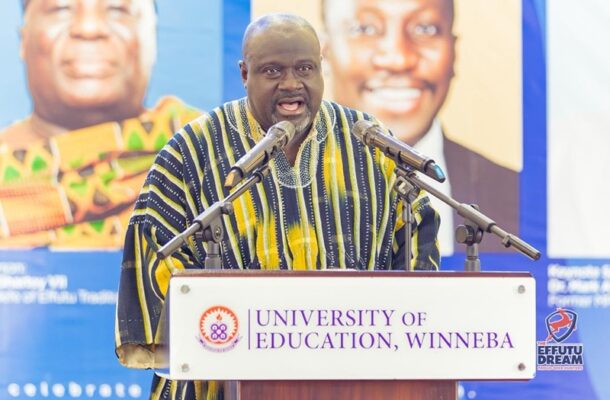
The remarkable journey of Minority Leader and Member of Parliament for Effutu, Alexander Kwamena Afenyo-Markin, from humble beginnings in Winneba to becoming one of the most influential political figures, took center stage at the Osahen Excellence Public Lecture held at the University of Education, Winneba.
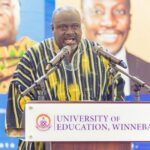
The lecture, delivered by economist and governance expert Dr. Mark Assibey-Yeboah, was organized under the theme “Selfless Leadership and Public Service: Building Integrity, Trust and Accountability.”
The event brought together traditional leaders, religious bodies, political figures, academics, students, and members of the public to reflect on the values required to strengthen democratic governance and public trust in leadership.
Speaking before a distinguished audience chaired by Neenyi Ghartey VII, Paramount Chief of the Effutu Traditional Area, Dr. Assibey-Yeboah argued that one of the greatest challenges facing modern democracies is the growing erosion of public confidence in leadership and public institutions.
He noted that while constitutions, laws, and institutions remain important pillars of governance, the true strength of any democracy lies in the integrity, accountability, and selflessness of those entrusted with leadership responsibilities.
According to him, societies thrive when leadership is rooted in sacrifice, honesty, courage, and accountability, but decline when public office becomes a platform for personal gain rather than service to the people.
He stressed that public office should be viewed as a sacred responsibility and not a privilege, insisting that leaders must place national interest above personal ambition.
From Bread Seller to Minority Leader
A significant portion of the lecture focused on the personal story of Afenyo-Markin, which Dr. Assibey-Yeboah described as an example of resilience, perseverance, and determination.
He recounted how the Effutu MP’s journey began in Winneba, where he supported his family through humble means, including selling bread to assist his mother during difficult economic times.
Those experiences, he said, shaped his understanding of hardship, discipline, and responsibility, values that continue to define his leadership approach today.
The lecturer traced Afenyo-Markin’s educational path from Winneba to St. Augustine’s College before pursuing legal studies at the University of Buckingham in the United Kingdom and later the Ghana School of Law.
He subsequently earned further qualifications in International Politics and Security from the University of Bradford.
Before entering active politics, Afenyo-Markin worked as a postal officer at Ghana Post and later ventured into private business through Excel Courier Ghana Limited, experiences Dr. Assibey-Yeboah said helped him appreciate the realities of work, entrepreneurship, and national development before assuming public office.
Rise Through Parliament
The lecture also highlighted Afenyo-Markin’s steady rise through Ghana’s parliamentary system, describing it as a reflection of his growing national responsibilities and commitment to democratic governance.
From serving as Member of Parliament for Effutu, he progressed through the ranks to become Deputy Majority Leader, Majority Leader, and now Minority Leader in the Ninth Parliament.
Dr. Assibey-Yeboah noted that throughout his parliamentary career, Afenyo-Markin has served on several key committees, including the Finance Committee, Public Accounts Committee, Defence and Interior Committee, Appointments Committee, Business Committee, and the Standing Orders Committee, giving him extensive experience in legislative oversight and national policy formulation.
The lecturer further observed that the Minority Leader has consistently advocated for stronger institutions, transparency, accountability, and parliamentary scrutiny of government programmes and expenditure, emphasizing that democracy flourishes when institutions are allowed to question power and hold governments accountable.
Championing Democratic Accountability
Dr. Assibey-Yeboah pointed to several parliamentary debates where Afenyo-Markin has taken firm positions on issues of national interest, including discussions on natural resource agreements and security governance.
According to him, the Effutu has repeatedly argued that transparency and accountability must remain central to the management of the natural resources and public finances.
He added that the Minority Leader has consistently maintained that Parliament’s oversight role is critical in ensuring responsible governance and safeguarding public resources.
He stressed that democratic governance requires leaders who are willing to subject themselves to scrutiny and embrace accountability rather than avoid it.
Culture, Tradition And National Development
The lecture also explored Afenyo-Markin’s role as Osahen (Chief Warrior) of the Effutu Traditional Area and his commitment to preserving cultural identity and promoting community development.
Dr. Assibey-Yeboah described the Aboakyer Festival as a powerful symbol of Effutu heritage, unity, and resilience, noting that Afenyo-Markin has consistently championed the importance of culture as a source of inspiration and identity.
Quoting the Minority Leader, he stated that “culture gives aspiration while history gives inspiration,” emphasizing the need for societies to preserve their traditions while pursuing modernization and development.
The lecturer argued that modern governance becomes stronger when it remains connected to community values, cultural identity, and social cohesion.
A Call to the Next Generation
Addressing students and young people at the event, Dr. Assibey-Yeboah urged the next generation to reject the notion that leadership is about status, visibility, or personal enrichment.
Instead, he encouraged them to embrace discipline, integrity, sacrifice, and service, stressing that the future of Ghana depends on young leaders who are guided by values rather than personal ambition.
He reminded the audience that leadership is temporary but legacy is permanent, noting that society ultimately remembers leaders for whether they united or divided people, strengthened or weakened institutions, and served citizens or themselves.
A Reflection on Leadership and Legacy
In concluding his address, Dr. Assibey-Yeboah said the public lecture was not merely a celebration of an individual but an opportunity to reflect on the values required to build stronger institutions, restore public confidence in governance, and inspire ethical leadership across Ghana.
He praised the Effutu Traditional Council, the Christian and Muslim communities, the University of Education, Winneba, and other stakeholders for organizing the event, describing it as a timely intervention at a period when trust, accountability, and integrity have become increasingly important in public life.











Comments (0)