
“The Concrete Is Not in the Best Condition” — Engineer Raises Alarm Over Quality of Materials in Avenor Collapse
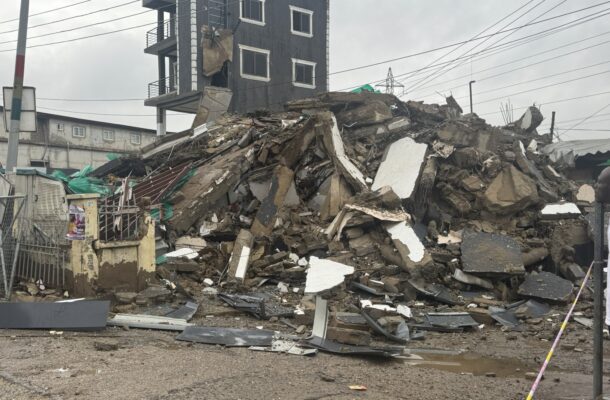
A structural engineer who visited the site of Sunday’s building collapse at Avenor has painted a troubling picture of the quality of construction that held the three-storey structure together — or rather, failed to — describing the concrete used as visibly substandard even without the need for formal testing.
Emmanuel Aidoo, a Professional Engineer with the Ghana Institution of Engineering specialising in structural engineering, told journalists that a visual inspection of the debris alone was enough to raise serious red flags about the materials used in the building’s construction.
“Visually, from the concrete, what I’m seeing is that you can clearly see that that concrete is not in the best condition,” he said.
Speaking on Joy FM’s Super Morning Show, Mr Aidoo explained that structural engineering standards require concrete to achieve a minimum compressive strength of 25 Newtons per square millimetre — a threshold he expressed serious doubt the building’s concrete ever reached.
He described the collapsed structure as a four-storey building, comprising a ground floor and three additional levels with a concealed roof, situated along a road he said he regularly travels. He was unequivocal that a building of that scale demands rigorous engineering oversight, not guesswork.
“This is not a single-storey building. These structures have to be engineered. You can’t just use your mind to construct such buildings. It will come back and haunt you,” he said.
Mr Aidoo noted that construction on the building is believed to have commenced around 2020 or 2021, making it approximately six years old at the time of its collapse — a detail that deepened his concern.
“For it to just come down, it’s an issue,” he observed.
He was careful to stress that his assessment was based purely on visual inspection, and that formal concrete sampling and structural analysis would be required before any definitive conclusions could be reached.
His remarks compound concerns already raised by fellow engineer Prince Kas-Avotri, also of the Ghana Institution of Engineering, who disclosed that the building appears to have been erected without a permit from the Accra Metropolitan Assembly — meaning no approved architectural or engineering drawings guided its construction from the ground up.
The Avenor collapse, which claimed two lives and left two others hospitalised, is the second such incident in Accra within the space of a single week, following the collapse of a building at Adenta New Site on June 3 that also proved fatal. The back-to-back tragedies have intensified scrutiny of building safety standards, regulatory enforcement and the culture of unchecked construction that continues to put lives at risk across the capital.













Comments (0)