
Ntonso youth declare war on unauthorized burials, mount round-the-clock vigil against outside dead
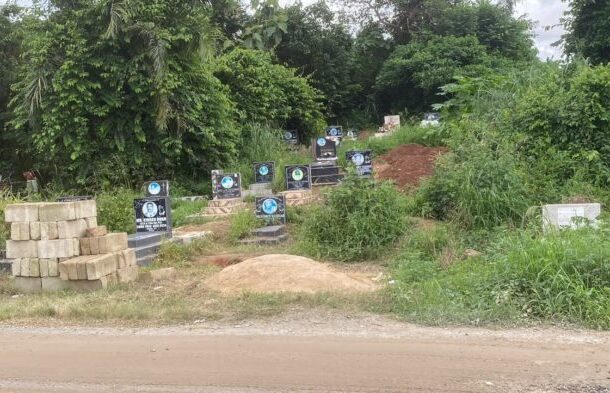
A community has militarised its graveyard, stationing youthful sentries across day and nocturnal hours to prevent what residents characterise as institutional violation of sacred space — the interment of deceased individuals lacking documented community affiliation or familial lineage within the territorial boundaries they regard as proper burial jurisdiction.
The Ntonso youth have weaponised their collective authority to transform cemetery access into a contested political arena, establishing the principle that no cadaver shall be committed to community soil without explicit approval cascading through recognised local institutional channels.
Their determination crystallised into physical action following Saturday’s exhumation operation, during which residents and youth mobilised to recover a body that had been buried allegedly without communal knowledge or consent.
The circumstances surrounding the unauthorised burial remain partially opaque. Community sources indicate the deceased had died under circumstances suggestive of criminal involvement — a detail that intensified rather than diminished community resistance.
Regardless of the death’s cause, residents insisted, the individual’s non-resident status disqualified him from burial within Ntonso’s consecrated ground.
The exhumation itself proceeded with institutional coordination. An ambulance and police vehicle had been observed entering the cemetery on the burial day, suggesting formal involvement in what residents regard as clandestine administrative procedure.
Yet that institutional presence apparently lacked community consultation or notification — a procedural bypass that galvanised youth response and prompted the cemetery’s subsequent reclamation of the body.
One youth member articulated the community’s jurisdictional claim with unambiguous intensity: “We heard the deceased was not from this community, and we will not allow anyone to bury strangers here without our consent.
If anyone attempts to do so again, we will resist it.”
The assertion extended beyond rhetorical positioning into institutional action.
The youth established permanent cemetery sentinels, staffing the burial grounds across twenty-four-hour cycles to intercept any attempted interment lacking documented community approval.
Their explicit warning conveyed that future unauthorised burial attempts would encounter physical resistance rather than passive acceptance.
Unit Committee Chairman Shadrack Addai endorsed the youth’s defensive posture, positioning community cemetery control as non-negotiable institutional principle.
The deceased in question has been returned to mortuary custody; Addai asserted that whoever bears responsibility for the burial arrangements must transport the corpse to the deceased’s legitimate hometown for interment rather than imposing the burial obligation upon Ntonso.
“We have been informed that the body has been returned to the mortuary. Whoever is responsible should arrange for the deceased to be buried in his hometown and not in Ntonso,” Addai stated, his formulation establishing that institutional sympathy rested with community sovereignty over cemetery usage.
The episode illuminates broader tensions between formal administrative processes and community assertion of collective control over shared resources and sacred spaces.
Law enforcement and health authorities may possess institutional authority over corpse disposition; yet communities maintain de facto veto power through their capacity to mobilise resistance against burial procedures they regard as institutionally inappropriate.
The Ntonso youth’s cemetery vigil represents an extreme articulation of community autonomy — an assertion that outsider dead shall not occupy communal burial ground absent explicit approval from residents who regard the cemetery as an extension of household and kinship rather than as public institutional resource.






Popular News
No trending posts found.