
Fix feed production, not just poultry projects – Poultry farmers urge government
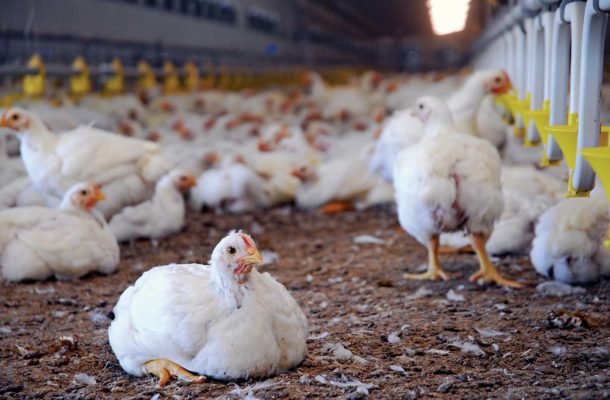
The Chief Executive Officer of the Greater Accra Poultry Farmers Association, Ali Muhammed, has called for a more comprehensive strategy to revive Ghana’s poultry industry, arguing that increasing local production of feed ingredients is essential to reducing the country’s dependence on imported chicken.
Speaking during a Joy Business roundtable discussion on the theme, “Can Ghana Feed Itself? The Future of Poultry Beyond Nkoko Nketenkete,” Mr Muhammed said government interventions alone would not transform the sector unless they addressed the structural challenges limiting production.
According to him, the biggest obstacle confronting poultry farmers is the lack of coordination among institutions responsible for agriculture, trade and input production, making it difficult for farmers to access affordable feed.
He noted that maize and soya, the two main ingredients used in poultry feed, remain in short supply locally, pushing up production costs and reducing the competitiveness of Ghanaian poultry producers.
“How do you increase your soya production? These are the major components in poultry production. There’s a total disjoint,” he said.
Mr Muhammed stressed that poultry farmers are not seeking temporary financial support but long-term policies capable of creating a sustainable and competitive industry.
“Whenever we approach these policymakers, we are not in for the freebies. We want this thing to be sustainable. But there’s a lack of coordination,” he added.
He also expressed concern about the state of institutions that support the poultry sector, particularly the veterinary services system, which he believes requires urgent reforms to improve efficiency.
Nkoko Nketenkete needs stronger support
Mr Muhammed said the government’s Nkoko Nketenkete initiative initially raised hopes among poultry farmers, who expected it to significantly boost local production.
However, he believes the programme has so far failed to tackle the fundamental issues affecting the industry’s growth.
“When we saw intervention being led by government, we said hallelujah. Government is going to do something wonderful. But after some few months into the first phase of implementation, we said no, no, no. It’s only a catching phase,” he said.
He maintained that creating a profitable business environment for poultry farmers should be the government’s priority.
As an example, he pointed to the recent glut of eggs on the market, which left many producers struggling to find buyers despite investing heavily in production.
“Why should the farmer, after going through all this hassle, raise birds, have these eggs, and there’s no market for egg products? It hurts a lot,” he lamented.
Feed costs remain the biggest challenge
Mr Muhammed further criticised the lack of integration within Ghana’s poultry value chain, saying crop farmers, feed manufacturers and poultry producers continue to operate without effective coordination.
He argued that increasing domestic maize and soya production and linking growers directly with feed manufacturers would significantly reduce production costs.
“The major input for poultry is actually the raw material for the feed. You talk about soya, you talk about maize. What is the coordination between the local farmers who plant the maize and the soya processors? There’s no coordination,” he stated.
According to him, imported frozen chicken continues to dominate the Ghanaian market because foreign producers benefit from lower production costs.
“The foreign frozen chicken is competitive because there’s one element called cost. The cost is manageable at their end. Without it, forget it,” he said.
Despite the influx of imported poultry products, Mr Muhammed believes Ghanaian consumers still prefer locally produced chicken but are often forced to buy imported alternatives because they are more affordable.
“The Ghanaian consumer knows the chicken that is best, and he can tell you the local chicken. But when the consumer gets to the market, it’s about disposable income against what he can afford. That’s the bottom line,” he said.
He called for stronger collaboration among government, farmers, feed producers, processors and marketers to build a resilient and competitive poultry industry capable of meeting local demand.
Ghana consumes an estimated 452,100 tonnes of chicken annually but produces only about 60,000 tonnes locally, leaving the country to import nearly 87% of its poultry requirements.
Closing that gap would require domestic production to increase to approximately 226 million birds each year—more than seven times current output of about 30 million birds annually.






Popular News
No trending posts found.