
All 26 UN agencies in Ghana join ongoing national clean up exercise in Accra

The international development apparatus has mobilised its full institutional weight behind Ghana’s attempt to sanitise communities ravaged by the June 29 deluge, with all twenty-six United Nations agencies operating within the country converging upon seven flood-affected regions to execute a coordinated environmental restoration campaign designed to prevent cholera, typhoid and other disease vectored through contaminated terrain.
The United Nations Public Health Expert in Ghana, Dr Fiona Braka, announced the comprehensive commitment during the launch of a two-day national cleaning exercise on Friday, July 10, framing international engagement as both humanitarian obligation and enlightened self-interest — flood-ravaged communities represent incubators for epidemiological crises that recognise no international boundaries.
“We were all affected by the recent flood situation that caused huge devastation and destruction of homes and property. We have also seen the need to clean up after that event, and that is why we are here,” Dr Braka stated, her comments positioning the UN response as organic institutional reaction rather than externally imposed intervention.
The mobilisation of all twenty-six UN agencies signals unprecedented institutional concentration of development apparatus toward singular objective — comprehensive environmental remediation across territories where precipitation had obliterated sanitation infrastructure and left landscapes festooned with contaminated sediment and decomposing material.
Dr Braka stressed the epidemiological stakes animating the exercise. Maintaining clean communities transcends aesthetic preference; it constitutes a bulwark against disease transmission.
Stagnant water, decomposing matter and contaminated soil create ideal breeding grounds and transmission vectors for pathogens that kill far more efficiently than the initial flood surge itself.
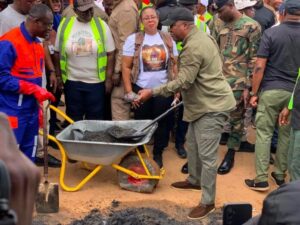
The government marshalled material resources necessary for the labour. Sanitation equipment including wheelbarrows, shovels and gloves were distributed to participants.
Security agencies, public sector workers and volunteer contingents mobilised in substantial numbers, suggesting that governmental coordination had succeeded in attracting broad institutional participation.
Friday’s activities concentrated upon institutional labour — security personnel, municipal assemblies and waste management companies directing organised clearing operations.
Saturday would transition to community-level participation, with residents and volunteer organisations assuming primary responsibility for cleansing their immediate environments.
President John Dramani Mahama had directed all government appointees — ministers, parliamentarians, state institution CEOs, municipal and district chief executives and public agency heads — to abandon their offices and lead cleanup activities within their respective constituencies.
The directive transforms what might have been routine institutional labour into symbolic participation by Ghana’s governing apparatus.
The exercise targets seven regions and the Greater Accra Region particularly, where the flood’s devastation concentrated most heavily.
The stated objectives encompass clearing drainage channels choked by debris, improving sanitation infrastructure and progressively enhancing the regions’ capacity to absorb future precipitation events without lapsing into catastrophic inundation.
The cleanup follows a meteorological catastrophe that claimed at least thirteen confirmed deaths, displaced thousands from their homes and inflicted extensive destruction upon residential structures, commercial establishments and public infrastructure.
The human toll continues to climb as recovery teams locate additional bodies and compile comprehensive casualty accounting.
The UN’s institutional mobilisation represents perhaps the most expansive coordinated international response to a single environmental crisis in Ghana’s recent history — a commitment that reflects both the unprecedented scale of the June flooding and the recognition that post-disaster disease outbreaks often claim more lives than the initial meteorological event itself.





Popular News
No trending posts found.