
Prez Mahama leads clean-up exercise in Tse Addo
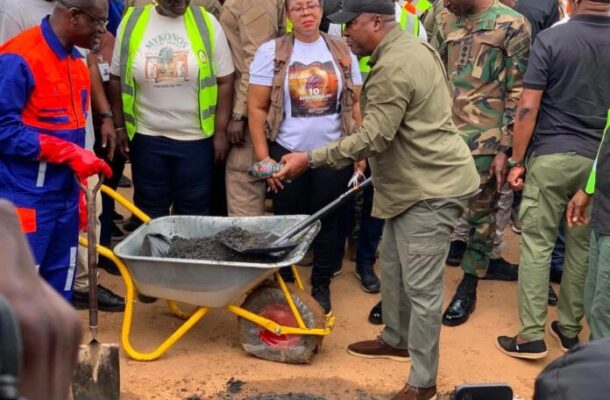
Ghana’s chief executive has exchanged his official regalia for work clothes, wading into contaminated drainage channels at Tse Addo to physically participate in the nation’s campaign to excavate decades of accumulated filth from infrastructure designed to convey stormwater but instead choked by the detritus of indiscriminate disposal.
President John Dramani Mahama arrived at the cleanup site on Friday, July 10, and immediately commenced labour alongside residents, security personnel and municipal officials, his hands engaged in the grimy work of hauling plastic-laden silt from channels that had been strangled into hydraulic dysfunction.
After receiving briefing from local assembly representatives, Mahama took spade to sludge, the dramatic visual of a sitting president engaged in manual labour designed to communicate governmental commitment to environmental remediation beyond rhetorical proclamation.
His observations during the exercise crystallised the environmental crisis into visceral language.
The material extracted from the drain — mountains of plastic debris intermingled with accumulated sediment — testified to the decades of disposal negligence that had progressively narrowed drainage capacity.
“I want to use this opportunity to thank all the residents who have come out to help with this exercise. Clearly, we can see what the cause of our problem is.
We’ve just desilted this. Look at the plastics that we are taking out of it,” Mahama stated, his words gesturing toward the tangible evidence of systemic environmental mismanagement.
The President pivoted toward a secondary but equally critical concern: the disposition of dredged materials following their extraction from drainage channels.
He cautioned against the widespread practice of depositing excavated debris along roadsides, explaining that subsequent rainfall washes those materials back into the very channels that had just been cleared, recreating the obstruction that desilting had momentarily relieved.
The observation illuminated a governance paradox: the labour of cleanup accomplishes nothing if poor practice recontaminates infrastructure during the interval between interventions.
Sustainable drainage function requires not merely episodic excavation but systematic waste management discipline to prevent re-accumulation.
Mahama reported that his tour across Accra had revealed encouraging participation rates.
The visible turnout suggested that the government’s call for collective action had resonated sufficiently to mobilise substantial residential engagement alongside official institutional participation.
The two-day exercise unfolding across seven flood-vulnerable regions represents governmental attempt to operationalise lessons learned from the June 29 catastrophe.
The desilting operations, waste removal campaigns and drainage restoration efforts comprise the practical foundation of what governmental rhetoric frames as commitment to environmental rehabilitation and flooding prevention.
Yet Mahama’s fieldwork commentary suggests institutional recognition that drainage maintenance alone cannot solve the underlying problem.
The plastic mountains being excavated represent deposits accumulated through years of citizen choice to dispose of waste into drainage systems rather than through formal waste management channels.
Preventing future flooding demands not merely infrastructure restoration but transformation of citizen behaviour regarding waste disposal.
VIDEO BELOW:




Popular News
No trending posts found.