
EU Ambassador calls for deeper reforms to sustain Ghana’s economic gains
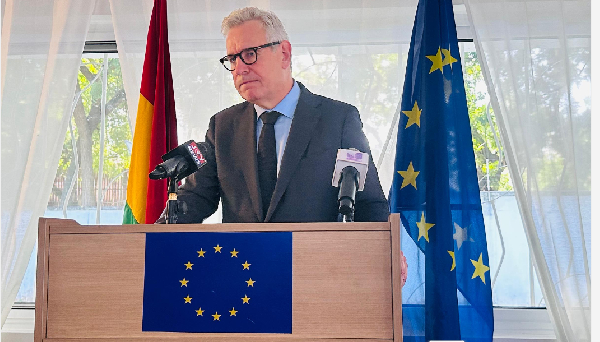
The European Union Ambassador to Ghana, Rune Skinnebach, has called for sustained structural reforms to safeguard Ghana’s recent economic progress, cautioning that current gains may not be durable without a stronger foundation.
Speaking at a media engagement in Accra to launch Europe Month, he acknowledged that Ghana’s economy is showing positive signs, including improved macroeconomic indicators and stronger-than-expected progress under ongoing reform programmes.
However, he warned that these gains are supported by fragile factors, particularly elevated global gold prices, which could expose the economy to volatility.
“The economy is doing great, but it is based on a very fragile pillar,” he stated, noting that heavy reliance on commodity-driven growth presents long-term risks.
Mr. Skinnebach explained that while recent fiscal and economic reforms have produced encouraging outcomes, sustaining the momentum will require disciplined policy implementation and economic diversification.
He stressed that Ghana cannot depend on favourable external conditions such as commodity price booms or periodic debt restructuring to drive growth.
“The success is based on reform, but also on external factors, and we cannot count on that every few years,” he said.
The Ambassador also highlighted domestic revenue mobilisation as a critical area for strengthening economic resilience, pointing out that revenue collection remains below potential.
“There should be a much better collection of taxes in a predictable and unified manner,” he added.
He further noted emerging pressures in key sectors such as cocoa and petroleum—traditionally pillars of Ghana’s fiscal stability—underscoring the need to diversify the economy and strengthen internal revenue systems.
According to him, although Ghana’s current economic trajectory has exceeded expectations, including those of international financial institutions, sustaining that performance will depend on prudent economic management and policy consistency.
Mr. Skinnebach emphasised the need to build a resilient economy capable of withstanding external shocks, especially in a volatile global environment marked by commodity price fluctuations and geopolitical tensions.
In that context, he said partnerships with reliable international actors such as the European Union could play a key role in supporting Ghana’s long-term development.
He noted that the EU remains committed to supporting Ghana through investments in infrastructure, job creation, and economic transformation initiatives aimed at promoting sustainable growth.
The Ambassador added that the EU’s engagement with Ghana is evolving from traditional aid to a more strategic partnership focused on shared priorities, including economic stability and private sector development.
He also highlighted ongoing EU-backed programmes targeting skills development, employment generation, and infrastructure improvements, particularly in underserved communities.
Mr. Skinnebach stressed the importance of accountability in public spending, noting that development interventions must deliver measurable benefits to citizens.
“We need to ensure that investments translate into real benefits for the people,” he said.
Describing Ghana as a country with strong economic potential, he emphasised that achieving long-term growth will require sustained commitment to reforms and sound economic governance.
He called for closer collaboration between government, development partners, and the private sector to drive inclusive and sustainable growth.
The engagement formed part of activities marking Europe Month, providing a platform for journalists to discuss Ghana’s economic outlook and explore opportunities for deeper cooperation with international partners.





Popular News
No trending posts found.