
16% of Accra’s drainage buffers swallowed by illegal construction
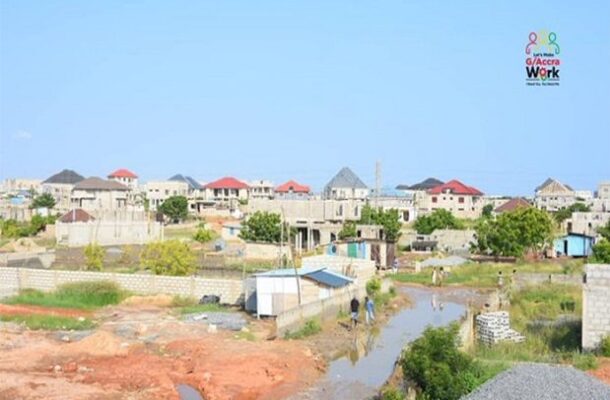
An audit of Greater Accra’s critical drainage infrastructure has quantified what residents discovered violently during Monday’s deluge: the waterways through which stormwater must flow have been systematically colonised by unauthorised structures, reducing the natural hydraulic capacity that once accommodated seasonal precipitation.
Nearly sixteen per cent of the legally mandated 25-metre buffer zones flanking major drainage channels across the metropolitan region has been seized by building encroachment, a loss that compounds the catastrophic flooding that displaced thousands and claimed lives as the capital’s storm management systems collapsed under precipitation they were engineered to handle.
The assessment, conducted by the Greater Accra Resilient and Integrated Development Project, examined geospatial data and field surveys spanning the interval between 2022 and 2026 across sixteen municipal and district assemblies.
The study’s focus centred upon the legally required setback on both drainage sides — a planning stipulation intended to preserve unobstructed waterways and permit maintenance access whilst reducing flood vulnerability.
The findings reveal a pattern of systematic encroachment despite explicit statutory prohibition. Across the sampled assemblies, a total of 10,497 structures have been identified occupying protected drainage reserve zones — physical impediments that fragment waterflow pathways and force stormwater to seek alternative trajectories often flowing through residential neighbourhoods.
GARID Project Coordinator Kojo Ohene Safo presented the assessment on Friday, July 3, articulating the spatial trend visible across the region.
Whilst Ablekuma Central recorded little change — the six encroaching structures documented in 2022 remained unaltered through 2026 — the overwhelming majority of assemblies documented mounting encroachment pressure.
Ayawaso Central witnessed a modest expansion from 793 structures to 801 between 2022 and 2026. Yet Ayawaso East experienced sharper escalation, with encroaching structures climbing from 337 to 494 over the identical four-year window.
Ga Central’s situation proved more acute. Between 2023 and 2025, an additional 54 structures arose within the assessed drainage corridor, bringing the cumulative total of encroaching buildings to 2,329 — a density suggesting that the waterway has been substantially colonised for residential and commercial purposes.
Krowor’s encroachment trajectory ascended from 178 structures in 2022 to 295 by 2026. Okai Koi North climbed from 596 to 729. Ablekuma West experienced one of the steepest escalations, jumping from 904 to 1,293 — an addition of nearly 400 illegal constructions within four years.
Ga North registered the most dramatic metamorphosis, with encroaching structures more than doubling from 1,049 to 2,261. Ga South rose from 746 to 871. La Dade-Kotopon increased from 544 to 638, whilst Adentan climbed from 171 to 214.
The cumulative effect amounts to a systematic narrowing of the channels through which Accra’s stormwater must be conveyed toward the sea. When precipitation volumes exceed what increasingly constrained waterways can accommodate, the excess saturates surrounding neighbourhoods in a deluge that becomes inevitable rather than exceptional.
Ohene Safo articulated the hydraulic consequence: “When we have the volume of rain that we do, the water doesn’t have a natural path. That will inevitably impact people it will affect them.”
The assessment emerges at a moment when national attention focuses upon flood mitigation following the catastrophic inundation of late June. Urban planning theorists have long identified the convergence of three variables as producing predictable flooding: encroachment upon waterways, indiscriminate construction within drainage reserves and weak enforcement of planning regulations.
The GARID findings now supply empirical confirmation that Accra has become progressively more vulnerable to precipitation events precisely because its drainage infrastructure has been progressively colonised by the very citizenry whose safety that infrastructure was designed to protect.
Government authorities have signalled that addressing the crisis demands multi-institutional collaboration. Local assemblies, urban planning bodies and enforcement agencies must coordinate enforcement operations to halt further encroachment and restore the hydraulic functionality that urban expansion has systematically compromised.
The Post-Flood Mitigation Committee is expected to leverage the GARID assessment in formulating engineering, planning and regulatory interventions aimed at reclaiming drainage corridors and progressively increasing Accra’s flood resilience.





Popular News
No trending posts found.