
Government delays finalisation of critical minerals policy three years after announcement
Three years after first announcing plans to develop a policy framework for the exploitation of critical minerals, the government says work is still ongoing on what is expected to become the country’s main regulatory guide for the emerging green minerals industry.
The delay comes at a time of intensifying global competition for minerals such as lithium, graphite, manganese and rare earth elements, driven by rising demand for electric vehicles (EVs), battery storage systems and other clean energy technologies.
The prolonged wait for a dedicated framework has also raised concerns among resource governance experts, who warn that Ghana risks missing a narrow window to secure stronger industrial and fiscal gains from the global energy transition economy.
Competing mineral-producing countries are increasingly moving to attract processing investments, strengthen local participation and negotiate better value-retention terms as demand for transition minerals accelerates globally.
It would be recalled that the then Minister of Lands and Natural Resources, Samuel Abu Jinapor, announced in May 2023 that a technical committee was finalising a policy document on the exploitation, management and utilisation of green minerals, including lithium, for Cabinet’s consideration.
“Our goal is to ensure that, as much as possible, we retain the value chain of these and other minerals in our country’s future,” Mr. Jinapor said at the time during a ‘Natural Resources Stakeholder Dialogue’ in Accra.
He further indicated that the government was putting in place the foundations for a “viable, sustainable, effective, efficient and environmentally-sound natural resources sector” capable of generating jobs and contributing meaningfully to national development.
According to him, the management of natural resources should not only focus on extraction and protection, but also on sustainability, environmental preservation and ensuring optimal benefit for citizens.
However, nearly three years on, the policy remains under development, with the country’s maiden lithium agreement now ratified.
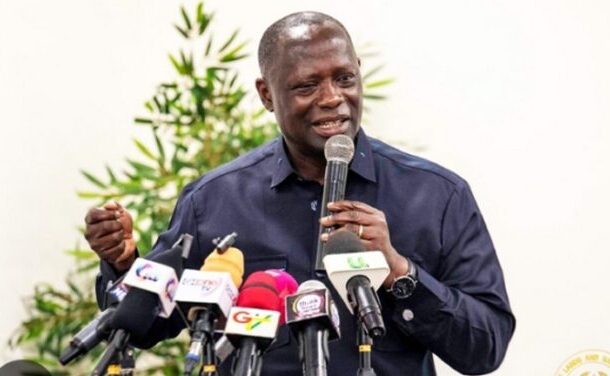
Speaking in response to questions on the status of the framework, the Minister of Lands and Natural Resources, Emmanuel Armah-Kofi Buah, said the government was still at the consultation and engagement stage.
“I want to say that we are working on the policies. We are still in a very early stage of engagement on a Green Minerals Policy, which is very important,” he said on the sidelines of a meeting with the Ghana Chamber of Mines in Accra.
The comments come amid growing debate over how Ghana intends to govern the exploitation of critical minerals, particularly following Parliament’s ratification of the country’s inaugural lithium lease last year.
That development sparked national discussions around royalty rates, local content provisions, value retention, downstream processing and whether the country is securing sufficient long-term value from its strategic mineral resources.
The Natural Resource Governance Institute (NRGI) Ghana Country Manager, Patrick Stephenson, has cautioned that Ghana’s opportunity to establish itself meaningfully within global lithium and transition mineral value chains remains limited.
According to him, decisions taken over the next few years will determine whether the country succeeds in capturing long-term industrial and fiscal benefits or continues the long-standing pattern of exporting raw materials while higher-value activities take place elsewhere.
The experts maintain that a dedicated policy framework will be critical in shaping the country’s approach to licensing, local participation, strategic partnerships, environmental safeguards, revenue management and downstream industrial development.
The policy is also expected to define Ghana’s response to growing calls for African resource-rich countries to move beyond extraction into higher-value processing and manufacturing linked to the global energy transition economy.











Comments (0)