
BoG rebrands Rural Banks as Community Banks under new microfinance reform

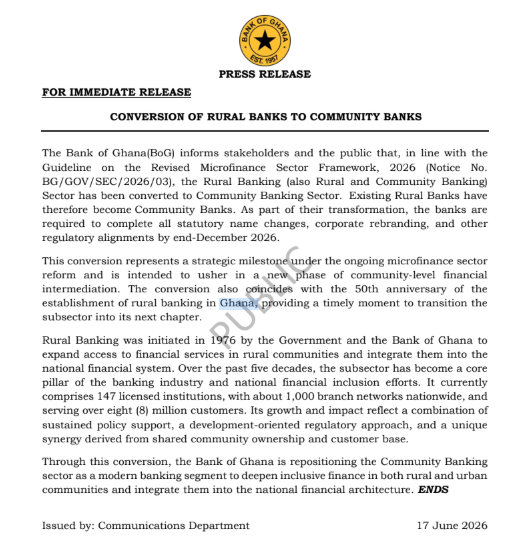
The Bank of Ghana (BoG) has announced the immediate conversion of all Rural Banks into Community Banks as part of a major reform aimed at modernising the microfinance sector and expanding financial inclusion across the country.
The directive, contained in the Guideline on the Revised Microfinance Sector Framework, 2026 (Notice No. BG/GOV/SEC/2026/03), officially redesignates all existing Rural Banks as Community Banks.
In a statement issued on June 17, the central bank described the move as a landmark step in the ongoing restructuring of Ghana’s microfinance landscape.
Under the new framework, all affected institutions are expected to complete the necessary legal name changes, rebranding exercises, and regulatory compliance requirements by December 31, 2026.
According to the BoG, the reform coincides with the 50th anniversary of rural banking in Ghana and marks the beginning of a new phase in community-focused banking services.
The central bank explained that the transition is intended to position Community Banks as modern financial institutions capable of serving both rural and urban populations while promoting greater financial inclusion nationwide.
“Through this conversion, the Bank of Ghana is repositioning the Community Banking sector as a modern banking segment to deepen inclusive finance in both rural and urban communities and integrate them into the national financial architecture,” the statement noted.
Rural banking was introduced in Ghana in 1976 through a collaboration between the Government of Ghana and the Bank of Ghana to provide banking services to underserved communities and encourage participation in the formal financial system.
Over the years, the sector has become an important component of the country’s financial inclusion strategy and banking industry.
The BoG indicated that the sector currently consists of 147 licensed institutions operating close to 1,000 branches nationwide and serving more than eight million customers.
The central bank attributed the sector’s success to sustained regulatory support, development-focused policies, and the community ownership model adopted by many of the institutions.
The conversion forms part of broader efforts to strengthen and modernise Ghana’s financial system while ensuring wider access to banking services for individuals and businesses across the country.
Although the Bank of Ghana did not indicate any immediate changes to ownership structures or daily operations, it stressed that all Community Banks must comply fully with the required regulatory and branding changes before the end of 2026.






Popular News
No trending posts found.