















ISSER warns Big Push infrastructure programme is yet to lift construction growth
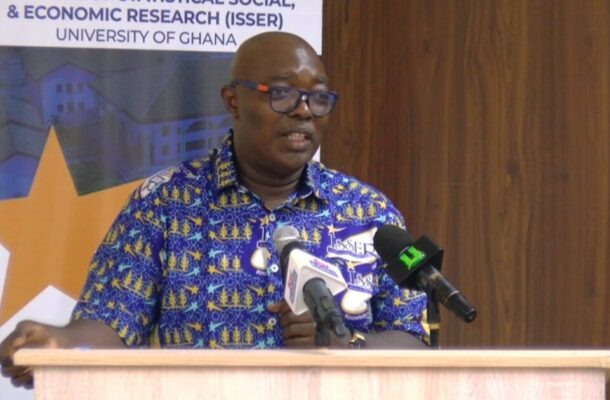
The Institute of Statistical, Social and Economic Research (ISSER) says the government’s “Big Push” infrastructure programme has yet to generate a significant increase in construction activity, with the sector recording growth of only 1.3% in the first quarter of 2026.
The institute raised concerns about the pace of implementation while presenting its review of the 2026 Mid-Year Budget. Its Director, Professor Robert Darko Osei, said the latest economic figures indicated that several flagship infrastructure projects had not yet translated into measurable economic activity.
ISSER said the construction sector’s modest first-quarter performance was particularly notable because the government has identified the Big Push as a major instrument for economic transformation.
“Construction grew by only 1.3% in 2026 Q1 despite the Government’s Big Push Infrastructure Programme. This suggests that many projects may be at the preparatory or early implementation stages, and hence, have not yet translated into stronger measured construction growth.”
The institute also linked the subdued performance to the government’s continued fiscal restraint. It argued that a significant reduction in capital expenditure had limited the resources available for infrastructure development.
“It also reflects the tight fiscal policy stance of the government (CAPEX decline was massive). Government is maintaining tight expenditure controls with no supplementary appropriation.”
ISSER acknowledged that the government’s fiscal consolidation measures had contributed to the restoration of macroeconomic stability. However, it cautioned that achieving sustained economic growth would require increased investment in productive infrastructure.
Data presented by the institute showed that capital expenditure during the first half of 2026 was 41% below target. That shortfall has prompted questions over whether reductions in public spending are slowing the delivery of major development projects.
Professor Osei said fiscal discipline remained important, but stressed that infrastructure investment needed to accelerate if the government was to support broader economic growth, generate employment and improve productivity across the economy.
The assessment comes as the government continues to promote the Big Push programme as a central part of its development strategy. However, ISSER’s review suggests that the pace of spending and project implementation has so far been insufficient to produce a stronger contribution from the construction sector.
The institute’s concerns focus not only on the amount of capital expenditure but also on the stage reached by the projects being funded. According to ISSER, many of the initiatives may still be in preparation or at the early implementation phase, meaning their wider economic effects have not yet appeared in official construction figures.
While the programme is intended to serve as a key driver of transformation, the 1.3% growth recorded in the first quarter points to a limited immediate impact. ISSER’s analysis therefore places renewed emphasis on the balance between maintaining tight control of public finances and ensuring that essential infrastructure projects progress quickly enough to support the economy.






Popular News
No trending posts found.