
Kumasi High School Alumni renovates school’s kitchen
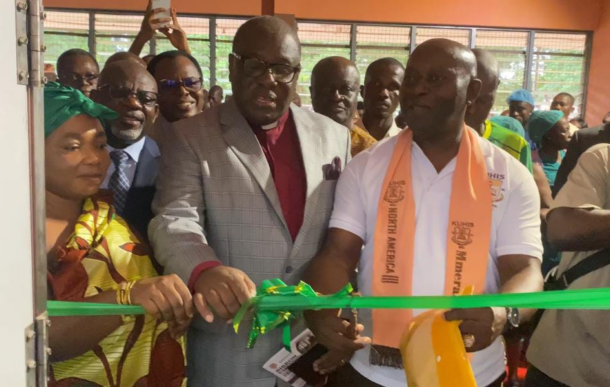
A North American alumni network has constructed a modernised culinary facility at Kumasi Senior High School, leveraging $85,000 in private donation to deliver what governmental institutions have systematically failed to provide — safe, efficient, hygienically sound large-scale food preparation infrastructure equipped with commercial-grade apparatus designed to protect both kitchen workers and the students they feed.
The smoke-free kitchen facility, unveiled during a commissioning ceremony, represents a stark indictment of institutional priorities within Ghana’s secondary education apparatus.
Whilst governmental investment has flowed toward classroom infrastructure, dormitory construction and library facilities, the spaces where thousands of students receive daily nutrition have languished in decay — many still relying upon firewood combustion that exposes kitchen personnel to chronic respiratory and ocular damage.
The facility, funded and executed by the alumni group Mmeranteɛ North America, arrives equipped with electronic commercial food-holding cabinets, a commercial tilting steam-jacketed kettle and stainless-steel utility trolleys — apparatus designed to systematise food preparation processes, eliminate manual labour bottlenecks and establish hygiene protocols that prevent contamination of meals prepared at scale.
Prof. Chris Mensah-Bonsu, Coordinator of the Kitchen Project and Vice President of Mmeranteɛ Global, articulated the indictment during the commissioning ceremony.
Government has invested substantially in secondary education infrastructure across multiple domains.
Yet kitchen modernisation has received conspicuously minimal attention despite representing a fundamental health and safety imperative.
“Government’s effort to build modern kitchens with ultra-modern equipment has not been encouraging.
A lot of kitchens in various SHSs are in a bad state. This is a threat to the safety of kitchen staff, students and, by extension, the national economy,” Mensah-Bonsu stated.
The health consequences of outdated kitchen infrastructure extend across multiple vectors.
Many school cooks rely upon firewood combustion, exposing themselves daily to smoke inhalation that accumulates into chronic respiratory pathology and progressive ocular deterioration.
The heavy reliance upon manual labour in food preparation increases contamination risks and places excessive physical burden upon kitchen personnel who labour under inadequate working conditions.
“With modern cooking equipment, we can improve food safety, reduce workload and protect the health of the people who feed our children every day,” Mensah-Bonsu observed.
Beyond occupational health, the environmental consequences of persisting with firewood-dependent cooking warrant institutional attention.
Modern commercial equipment reduces dependence upon biomass fuel, decreasing deforestation pressure and contributing measurably to climate change mitigation efforts through reduced carbon-intensive fuel consumption.
Mensah-Bonsu encouraged other alumni associations to emulate Mmeranteɛ North America’s initiative and partner with government to establish a comprehensive national programme upgrading secondary school kitchens across the country.
The donation demonstrates that private sector commitment combined with institutional will can transform educational infrastructure.
Larry Osei Koduah, Chairman of Mmeranteɛ North America, addressed the imperative of equipment stewardship.
The facility was designed for multi-generational service; its longevity depends entirely upon rigorous maintenance and responsible operational discipline.
The alumni group has trained kitchen personnel and dining hall prefects in equipment operation and conducted ongoing monitoring, yet primary responsibility for daily care rests upon school institutional commitment.
“We have trained the cooking staff and dining hall prefects on how to use these machines, and we will continue to monitor the facility and support the school where needed.
However, the day-to-day care must come from the school,” Koduah stated.
School authorities acknowledged that the donation arrives at a moment of acute institutional stress.
The Free Senior High School policy has expanded access dramatically, placing unprecedented pressure upon school feeding systems designed for substantially smaller populations.
The new kitchen addresses immediate equipment capacity; yet supporting infrastructure remains inadequate.
Kumasi Senior High School’s Headmaster Benjamin Tawiah Twum expressed gratitude to donors whilst immediately pivoting toward the next infrastructural necessity.
Although the kitchen now meets contemporary standards, the dining hall itself remains in dilapidated condition — inadequate to accommodate the student population and unable to provide an environment befitting the new kitchen’s capabilities.
“We are very grateful for this ultra-modern kitchen. However, our dining hall is also in a bad state. I appeal to the old students to come to our aid and help renovate it so it befits the new kitchen and provides a conducive environment for our students,” Twum appealed.
The donation has catalysed broader institutional conversation regarding comprehensive assessment and systematic upgrade of secondary school feeding infrastructure.
The convergence of expanded student populations under the Free SHS policy and accumulated years of maintenance neglect has created cascading institutional dysfunction wherein individual facility improvements lack surrounding infrastructure necessary to realise their intended impact.





Popular News
No trending posts found.