
Dangote eyes World’s largest refinery as African Fuel expansion gains momentum
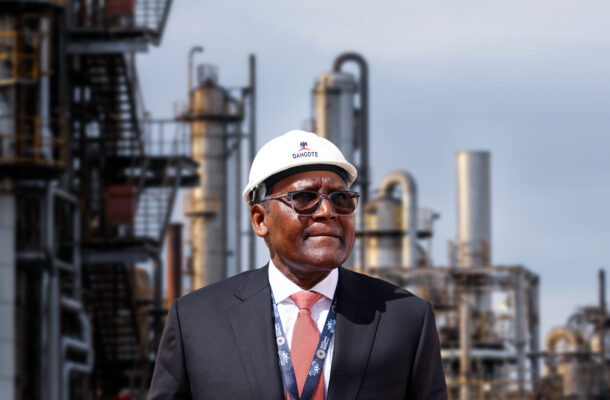
Nigeria’s Dangote Petroleum Refinery is accelerating its ambitions to dominate Africa’s refining industry after increasing production capacity to 700,000 barrels per day (b/d) and significantly expanding fuel exports to Europe.
The Lekki-based refinery has been operating at full capacity over the past two months, driving record exports of refined petroleum products and overtaking traditional suppliers from the Gulf and the United States in some European markets.
Its growing output has already transformed West Africa’s fuel trade. Imports of clean petroleum products from outside the region declined by nearly 25% year-on-year during the second quarter, reflecting the refinery’s increasing influence on regional supply.
Expansion Plans
Dangote Group now plans to take the refinery to the next level by constructing an additional 750,000 b/d crude distillation unit (CDU), which would increase total refining capacity to 1.45 million b/d. If completed, the Lekki facility would become the world’s largest refinery, surpassing Reliance Industries’ 1.4 million b/d Jamnagar Refinery in India.
The expansion will also include additional secondary processing units and increased production of polypropylene, base oils and linear alkyl benzene, alongside a broader network of fuel storage and distribution facilities across Africa.
The refinery recently increased capacity from 650,000 b/d to 700,000 b/d through upgrades and de-bottlenecking of its existing CDU, a process that took approximately two and a half years after regular crude processing began in March 2024.
Although Dangote aims to complete the new CDU by December 2028, industry observers believe the timeline may be ambitious, considering the first refinery took about eight years to build.
Growing Pressure on NNPC
Despite questions over the project’s timeline, analysts say the expansion announcement sends a strong signal to competitors, particularly the Nigerian National Petroleum Company (NNPC), which is still seeking investors to rehabilitate its three state-owned refineries with a combined capacity of 445,000 b/d.
The proposed expansion reinforces Dangote’s position as the dominant player in Nigeria’s refining sector while intensifying competition across Africa.
Diversifying Crude Supply
The refinery has relied primarily on Nigerian crude oil, but domestic production has not always been sufficient to meet its growing demand.
Crude deliveries reached nearly 650,000 b/d in May before declining to 575,000 b/d in June.
While Bonny Light remains the refinery’s main feedstock, Dangote has also sourced crude from the United States and expanded its crude slate to include heavier Nigerian grades such as Escravos, Forcados and Bonga, as well as occasional cargoes from Libya, Cameroon, Ghana and Guyana.
The broader mix of light and medium crude grades has improved the refinery’s ability to produce larger volumes of gasoline and diesel.
Record Exports to Europe
Jet fuel has emerged as Dangote’s biggest export success.
Nearly half of the refinery’s product exports in June consisted of jet fuel, reaching a record 145,000 b/d, with most shipments destined for Europe.
Around 96,000 b/d was exported to the Amsterdam-Rotterdam-Antwerp (ARA) trading hub, making it the refinery’s largest export destination.
The shift has altered Europe’s traditional supply chain, where Gulf producers and India have historically dominated jet fuel exports.
Although the European market has recently moved from supply shortages to oversupply, Dangote’s relatively low production costs are expected to keep its exports competitive even as refining margins decline.
Strengthening West African Supply
While jet fuel is largely exported to Europe, most of Dangote’s diesel production remains within Africa.
The refinery’s growing exports have significantly reduced West Africa’s dependence on imported refined petroleum products from countries such as Belgium, the Netherlands, Spain, India and Russia.
Nigeria is increasingly becoming the region’s primary supplier of clean petroleum products.
Continental Expansion Strategy
Dangote’s long-term strategy extends beyond refining.
The company plans to build a 1.6-million-barrel gasoline and diesel storage terminal in Walvis Bay, Namibia, which could supply fuel to Botswana, Zimbabwe, Zambia and eventually South Africa.
South Africa represents a major opportunity, with domestic refineries supplying only about a quarter of the country’s 405,000 b/d fuel demand, leaving the remainder to imports.
The group is also evaluating plans for a 700,000 b/d refinery in Mombasa, Kenya, a project estimated to cost $17 billion and expected to take approximately five years to complete.
Infrastructure Challenges Remain
Despite its rapid growth, Dangote’s continental expansion faces significant hurdles.
Limited fuel storage infrastructure, inadequate transport networks and security concerns continue to pose challenges to fuel distribution across Africa.
The company has ruled out relying heavily on pipelines within Nigeria because of security risks and instead transports products using compressed natural gas (CNG)-powered trucks.
Analysts believe sea-based distribution through ports such as Lekki and the proposed Walvis Bay hub may offer a more practical solution than an extensive pipeline network.
With record exports, rising refining capacity and ambitious expansion plans, Dangote has already reshaped Africa’s fuel market. The next challenge will be transforming that success into a continent-wide refining and distribution network while overcoming infrastructure, security and market uncertainties.





Popular News
No trending posts found.