
Mahama’s Approval Soars to 71% as Most Ghanaians Signal Optimism About Country’s Direction

President John Dramani Mahama is riding a wave of public confidence, with his job approval rating climbing to 71 percent in the latest National Tracking Poll released on Sunday, June 15 — the highest mark any sitting leader has achieved in the polling firm’s regular surveys since 2020.
Global InfoAnalytics’ June 2026 study shows the President’s standing has strengthened from the 67 percent recorded three months earlier, while disapproval has fallen to just 23 percent, with 6 percent declining to express a view.
#image_title
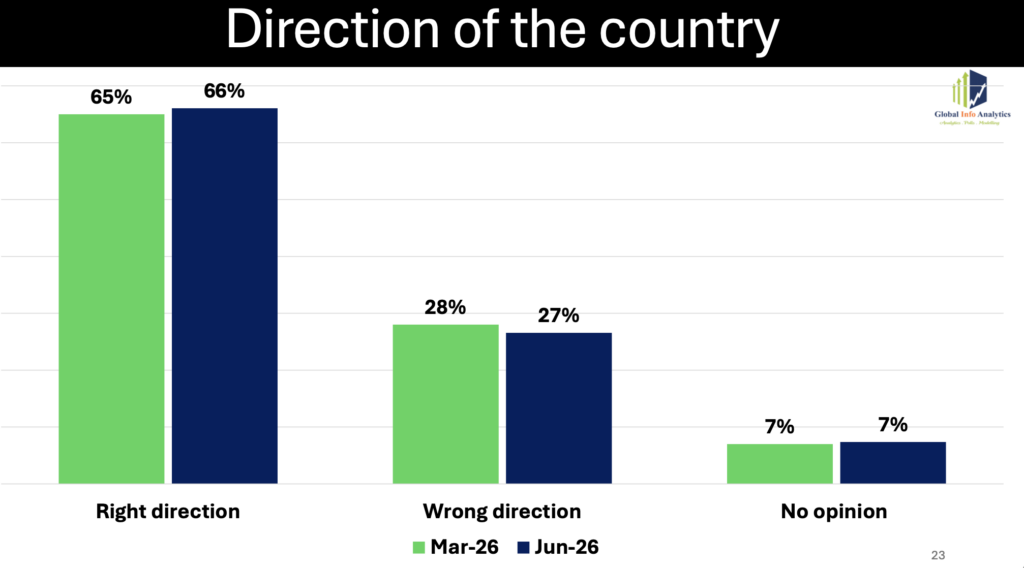
The broader national mood reflects similar optimism. When asked about the country’s trajectory, 66 percent of Ghanaians believe Ghana is moving in the right direction, a figure that remained stable from the March survey. The opposing view — that the nation is headed the wrong way — is held by 27 percent.
Regional breakdowns reveal enthusiasm stretches across the country, though unevenly. The Savannah and Western North regions produced the strongest endorsements at 86 and 82 percent respectively.
The Western region returned 76 percent approval, Greater Accra 73 percent, and the Central region 70 percent. Support dipped more noticeably in the Ahafo region, which recorded 40 percent, followed by the North East at 52 percent and Ashanti at 55 percent.
#image_title
The partisan divide, however, tells a starkly different story. Nine in ten NDC voters approve of the President’s record, while only 6 percent disapprove. NPP sympathisers present the inverse picture — just 37 percent approve while 54 percent disapprove.
Floating voters, who hold no party allegiance, granted the President 65 percent approval with 22 percent registering disapproval.
When evaluating government performance as a whole, nearly half — 47 percent — described it as very good or good, while a further 22 percent used the word “excellent.” Only 13 percent said performance has been poor or very poor.
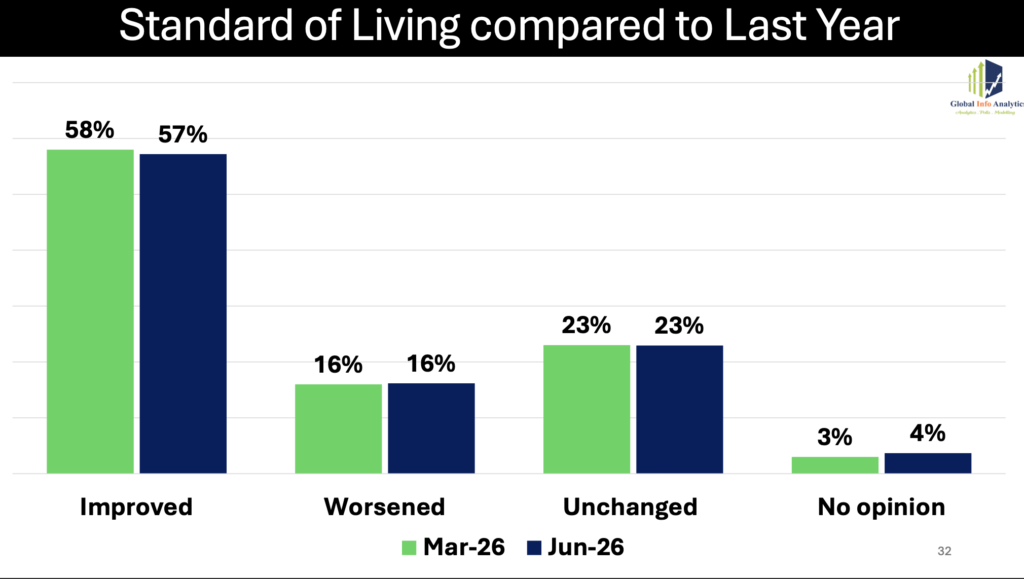
On the economic front, personal sentiment tilts positive. Fifty-seven percent reported that their standard of living has improved over the past year, while 16 percent saw it worsen and 23 percent detected no change. Forward-looking sentiment remained buoyant, with 68 percent expecting their circumstances to improve over the coming twelve months.
Yet optimism coexists with concerns. When respondents were asked to identify areas where government is underperforming, three issues dominated: unemployment topped the list at 44 percent, followed by the general state of the economy at 32 percent, and erratic power supply at 29 percent.
On the governance front, 54 percent of Ghanaians believe the state has moved in the right direction on combating corruption, while 21 percent detected deterioration.
When queried on which state institution is best equipped to fight graft, 36 percent saw the Attorney General and Office of the Special Prosecutor as equally capable. Among those expressing a preference, 24 percent favoured the Attorney General and 16 percent chose the Special Prosecutor.
The poll also probed attitudes on school discipline and examination integrity.
Two-thirds of respondents — 67 percent — backed the public display of photographs of adults caught cheating on exams as a deterrent, with only 13 percent opposed.
On school discipline, opinion was more divided: 38 percent favoured the restoration of corporal punishment, 27 percent preferred suspension, and 20 percent backed community service.
On the question of future political direction, a solid majority — 57 percent — expressed a preference for younger leadership going forward, compared to 26 percent who favoured maintaining the status quo.
The sentiment was strongest in the Savannah region where 89 percent leaned toward younger leaders, and the Upper West where 82 percent held the view.
The Ashanti, Bono and Western North regions showed less enthusiasm for generational change.
When pressed on what age they would consider too advanced to hold office, 21 percent said age should be irrelevant, 17 percent set a threshold of 50 to 54 years, while 46 percent drew the line at 65 and above.
The survey sampled 8,784 voters between May 30 and June 12, 2026, spanning all 16 regions and 84 constituencies. Of those, 7,484 participated in face-to-face interviews while 1,302 responded online.
The poll operates with a 99 percent confidence level and a margin of error of 2.5 percent.














Comments (0)